In 2012, the malaria situation were rather complicated in the Central - Western Highland region. The statistics of the regional provinces showed that malaria cases in 11 months of 2012 in the Central - Western Highland region increased by 7.55% in comparison with the same period last year (15,040/16,176), with the Central Coastal area +5.93% (7296/7973) higher, and the West Highlands +9.28% up (7744/8203). The provinces with increased malaria cases against the same period of 2011 were: Quang Binh (11.32%); Quang Ngai (15.30); Phu Yen (39.74%); Khanh Hoa (2.79%); Ninh Thuan (14.26%); Binh Thuan (1.67%); Gia Lai (31.25%). The malaria parasite proportion in the whole region raised by 23.86% in comparison with the same period last year, including the Central Coastal area (+13.19%), and the West Central Highland (+34.88%); the provinces which had the increased malaria parasite proportion were Quang Binh (146.94%), Quang Nam (56.45%), Phu Yen (41.07%), Khanh Hoa (38.34%), Ninh Thuan (15.50%); Gia Lai (42.50%), Kon Tum (11.11%), Dak Lak (28.21%), Dak Nong (50%).
Severe and complicated malaria cases declined by 12% (81/93) compared with the same period last year. Malaria mortality didn't decrease in comparison with the same period last year (6/6). The provinces which had malaria deaths were Binh Dinh (1), Phu Yen (3), Khanh Hoa (1), Binh Thuan (1). No malaria outbreaks occured in 11 months of 2012.
The cause of malaria increase: according to the provinces' reports, the increased malaria cases were found mostly in mobilised pupolations (forest-goers, field-hut sleepers, people doing forest-relating works or returning from Western Highland provinces). These subjects' self protection methods didn't show fully effective. Besides, the budget of the National Malaria Control Program was slowly allocated to some regional provinces, thereby delaying the local malaria control activities (not until June 2012 the provinces could receive the budget). The overuse of rapid diagnostic tests may cause the increase of malaria cases and malaria parasites.
 |
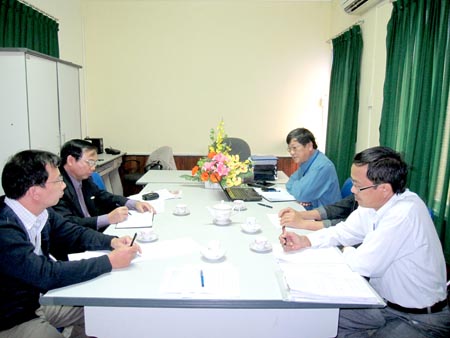 |
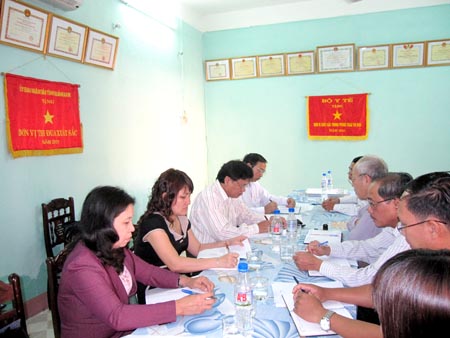
Dr. Nguyen Van Chuong, Director of IMPE-Quy Nhon and the staff mission working with
the Provincial Centres of Malaria Control/Preventative Medicine of Quang Nam and Phu Yen |
The leaderships of the IMPE-Quy Nhon has worked with health centres of 15 regional provinces on malaria control and other vector-borne diseases to keep track of malaria situation and activities of Global Fund for malaria control; directed some of provinces with increased and varying rate of malaria morbidity such as Gia Lai, Dak Nong, Binh Thuan, Quang Tri, Quang Nam, Quang Ngai, Binh Dinh, Khanh Hoa. The Institute leadership directed the strengtheningof surveillance activities, especially timely detection of infected cases and prompt support of insecticides, bednets and anti-malarial drugs for hot-spots of malaria; directed some of provinces having border malaria such as Quang Tri, Thua Thien Hue, Dak Nong, Kon Tum to hold meetings on border malaria control measures as well as participate in border malaria worshops of Vietnam-Lao PDR-Cambodia.
 |
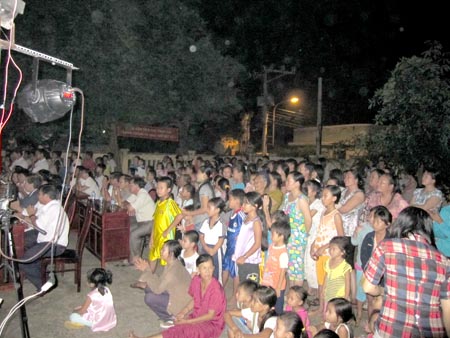 |
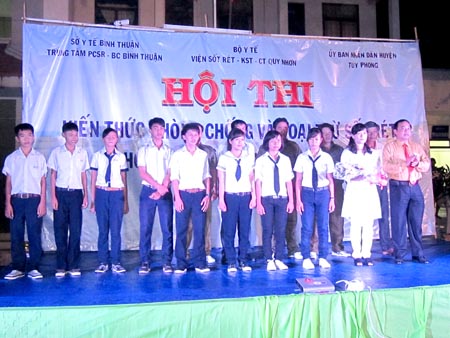
IMPE-Quy Nhon organising "Competition on malaria control knowledge for ethnic minorities"
in Binh Thuan province |
Besides, the surveillance missions from Departments of Epidemiology, Clinic Research and Treatment, Entomology has organised the surveillance, investigation and training courses for the provinces sponsored by the Global Fund on diagnosis and treatment, drug resistance, vector surveillance, sensitivity testing and microscopic sites, etc. Another effective malaria control measure is the "Competition on malaria control knowledge for ethnic minorities" which was organized for ethnic minorities in remote areas of Dak Lak and Binh Thuan province with an aim of exploring their knowledge, behaviour and practice on malaria and control measures.
OnJanuary 14th 2013, the leadership of IMPE-Quy Nhon sent the document to Health Services and the provincial centres of malaria control/preventive medicine to strengthen surveillance activities and malaria control in the first months of 2013 with the contents as follows:
1. The provincial centres of malaria control/preventive medicine direct malaria control activities in first months of 2013 effectively, strengthen protective measures for high-risk groups (mobilised people, people going to work in the forests, sleeping in the field huts and crossing borders, children and pregnant women).
2. Strengthen early diagnosis and treatment of malaria patients according to the regimen of the Ministry of Health right from village levels.
3. In severely-hit areas, appoint the staff to the localities to analyse and forecast the malaria situation and support in directing the implementation of malaria control measures.
4. Send the document to districts/towns, including areas with no fluctuation of malaria to warn the increase of malaria and strengthen surveillance measures.
5. Frequently send reports on malaria situation in severely-hit areas and malaria deaths (if any) to IMPE-Quy Nhon to give directive and supportive measures timely.