The Institute of Malariology, Parasitology and Entomology Quy Nhon (IMPE-Quy Nhon) is a constituent body belonging to the Ministry of Health, has the functions of conducting scientific research into malaria, other parasitic and vector-borne diseases and applying control measures; providing specialised guidance for lower-level units; organising trainings and re-trainings for medical staff in the field of malariology, parasitology and entomology in 15 coastal and highland provinces of Central Vietnam. Experiencing thirty-five years' development (1977-2012) in association with every country's historical period, the Institute staff has strived to work efficiently and creatively under any difficult and challenging condition superbly fulfill their delegated duties.
The establishment process of the Institute
Malaria Research Station in the middle area of Central Vietnam (1968-1976)
In the situation of the Resistance against America, Central Vietnam, where Truong Son road is lifeline transportation to connect the North with the South, usually happened fierce battles. In addition, malaria epidemic was raging drastically and affected fighting force as well as productive force of soldiers and people; thus the Malaria Research Station in the middle area of Central Vietnam was set up in 1968.
With the mission of protecting the country and caring public health, the staff of Malaria Research Station overcame difficulties and hardships of the fierce war to control malaria epidemic, protect health for millions of people and soldiers in the battlefields of Zone V, contributing significantly to the liberation of South Vietnam and regaining national unification.
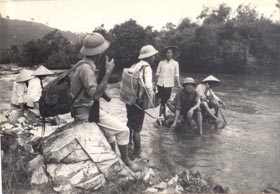 | 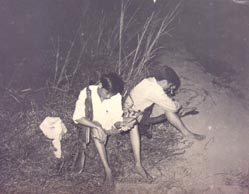 |
Medical staff both defending the country and participating
in technicalactivities in remote areas. | Entomology Department Staff implementing
their missions |
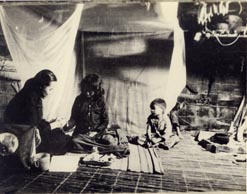 | 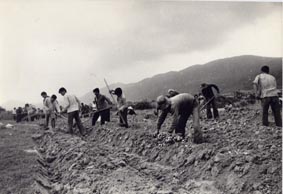 |
Take blood-smears for detection of malaria parasites | Participate in both technical and productive activities |
Sub-Institute of Malariology, Parasitology and Entomology (1977-1997)
After the South was completely liberated, the Sub-Institute of Malariology, Parasitology and Entomology Quy Nhon was set up from Malaria Research Station in Central Vietnam on 8 March 1977 to respond the development of country in new historical period.
Because of the consequences of the war and the difficulties of economic situation, malaria outbreaks occured drastically with 58 ones, including 699,000 cases of morbidity, 3,976 deaths. Especially, in the period 1991-1992, there were tens of malaria outbreaks with hundreds of thousands of malaria cases and thousands of deaths, which affected health and life of people.
In this period, the Sub-Institute deployed specialised and technical measures on malaria control to reduce malaria outbreaks, morbidity and deaths. Moreover, the staff of the Sub-Institute worked indefatigably to contain the outbreaks and alleviate the damages by malaria for the people of Central Vietnam, contributing to the socio-economic development in the country.
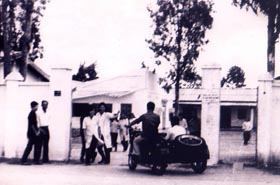 | 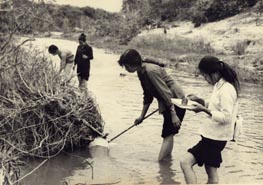 |
Sub-IMPE in 1977 | Surveillance activities of mosquito larvae at streams
for research work |
Institute of Malariology, Parasitology and Entomology (1998 to now)
According to the Decision No.230/1998/QD-TTg dated 30 November 1998 of Prime Minister on arranging research institutes and deploying the application of science and technology, the Sub-Institute of Malariology, Entomology and Parasitology Quy Nhon was renamed the Institute of Malariology, Entomology and Parasitology Quy Nhon (IMPE-Quy Nhon) and took charge of conducting scientific research, directing technical measures for lower levels and training for medical staff on malaria, parasitic and vector-borne diseases and control measures in 15 provinces of Central coastal and highland areas.
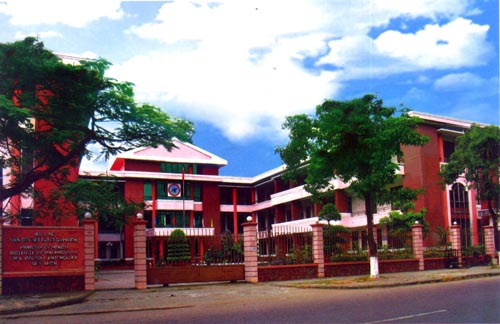 |
IMPE-Quy Nhon |
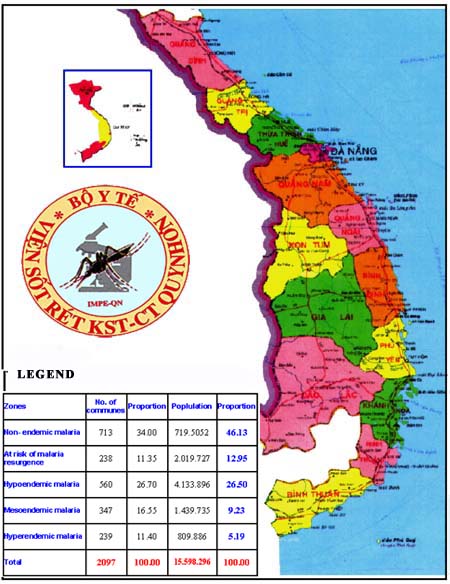
Although malaria situation of the whole country tended to decline drastically, the burden of malaria control still concentrated in the coastal and highland provinces of Central Vietnam, with about 50% of morbidity, 70-80% of parasite rate, 75-83% of severe and complicated malaria and 72-86% of mortality, compared with the whole country. High malaria infections were mainly due to low awareness of the people at malaria-endemic areas; moreover, these areas usually confronted with disasters and floods annually; so the risk of malaria increased highly and outbreaks can occur at anytime. The IMPE-Quy Nhon deployed research activities and intergrated measures to decrease malaria indexes according to the proposed targets. In addition, the IMPE implemented timely inspection and dectection of heminthiasis (fascioliasis, opisthorchiasis, taeniasis, toxocariasis, strongiloidiasis, gnathostoma, etc.) and vector-borne diseases, contributing to improvement and protection of public health.
ADMINISTRATIVE MAP OF COASTAL AND HIGHLAND PROVINCES OF CENTRAL VIETNAM
 |
|
Obtained achievements of IMPE-Quy Nhon
Epidemic disease control
Malaria control
With the specific characteristics of Central Vietnam, the effective containment of malaria in this region could preliminarily solve the whole country's malaria situation; therefore, in the past 5 years (2005-2010), the Institute attached special importance to the quality improvement of spraying and bed-net impregnation with insecticides, to the capacity enhancement of diagnosis, treatment and management of malaria patients for health networks at all levels. Besides, the Institute also strengthened the direction, inspection and supervison of the annual anti-malaria plans, especially assigned mission teams for epidemiological, entomological, parasitological and malarial therapeutic surveilance; provided technical assistance for severely-hit areas of malaria infection and areas at high-risk of malaria outbreaks, seriously affected by typhoons/floods and with difficulties in the implementation of epidemic control measures. In particularly, from January 2009 to April 2010, malarial indexes tended to increase continuously over 15 consecutive months, resulted from long spell of floods which facilitated the development and pathogenetic ability of malarial mosquitoes and difficulties in management of mobile populations into malaria-endemic areas (free immigrants, forest goers and sleepers, cross-border objectives, etc.). The Institute has actively supported the timely epidemic control in provinces hit by floods and assigned many mission teams in collaboration with local health authorities to carry out supplementary malaria control measures for mobile groups, containing the malaria outbreaks and lowering the proportion of disease infection as set forth by anti-malaria targets.
Malarial indices in Central Vietnam (2005-2010)
No. | Indices | 1991 | 2005 | 2006 | 2007 | 2008 | 2009 | 2010 | % (-,+) 1991-2010 | % (-,+) 2005-2010 |
1 | Malaria patients | 205.222 | 41.149 | 38.351 | 25.038 | 19.485 | 22.331 | 21.302 | -89,62 | -48,23 |
2 | Severe and complicated malaria cases | 9610 | 179 | 192 | 97 | 85 | 113 | 109 | -98,87 | -39,11 |
3 | Malaria deaths | 1777 | 13 | 25 | 13 | 14 | 16 | 8 | -99,55 | -38,46 |
4 | Slide positive rates | 12,27 | 1,48 | 1,54 | 0,93 | 0,69 | 1,03 | 1,14 | -90,71 | -22,97 |
5 | Malaria outbreaks | 9 | 0 | 0 | 0 | 0 | 0 | 0 | -100 | 0 |
In reference to the malaria indicators of 2010 in comparision with those of 1991, the malaria explosion period with 205,222 malaria patients, 9,610 severe and complicated malaria cases, 1,777 malaria deaths and dozens of malaria outbreaks, the morbidity cases reduced to 19,471(90.51%), severe and complicated malaria cases to 100 (98.96%). The mortality also declined by 99,55% (8 deaths) in the absence of malaria epidemics within over 10 recent years, by which it means that malaria outbreaks were contained and rolled back little by little.
As compared to 2005, it was reported a decrease in malaria patients in 2010 by 48,23%, severe and complicated malaria cases by 39,11%, malaria deaths by 38,46% and malaria parasites by 22,97%.
Compared with 2009, cases of malaria morbidity, mortality, severe and complicated malaria in 2010 also dropped by 4,61%, 50% and 3,53%, respectively, malaria parasite rate raised by 10,67%; there were no malaria outbreaks from 2005 to 2010.
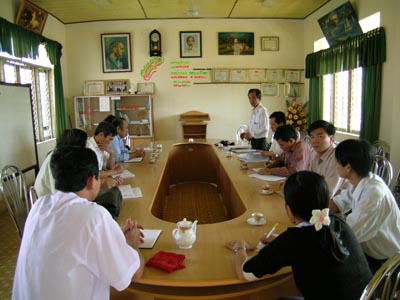 |
The Institute leadership and concerned departments supervising and directing
the malaria control in 15 central provinces of Vietnam |
Dengue control
From 2009 until now, the IMPE-Quy Nhon has been commissioned to implement the dengue control project in Central Vietnam by the Ministry of Health. In 2010, the dengue outbreaks occurred throughout the region with the cases of morbidity and mortality of nearly 90,000 and 55, respectively; many provinces announced dengue fever epidemics. Confronted with this situation, the Institute in collaboration with the Nha Trang Pasteur Institute, the Institute of Hygiene and Epidemiology of Tay Nguyen and centres for preventive medicine in regional provinces timely deployed proactive epidemic control measures, studied vector composition, conducted experiments on the sensitivity of dengue mosquitoes to insecticides, educated and mobilized the community to actively destroy the breeding sources of larvae for mosquito control, contributing to the containment of outbreaks, morbidity cases and deaths from dengue fever. In the implementation process, the Institute also put forward the effective epidemic control measures, especially the plan for winter dengue control as directed by the MoH so as to early prevent epidemic diseases from occuring and breaking out in 2011.
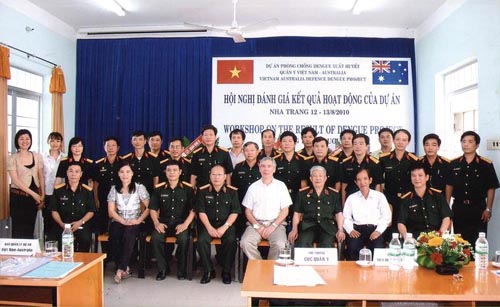 |
International and domestic cooperation in dengue fever control |
Fascioliasis and parasitic disease control
Since 2005 up to now, fascioliasis has broken out on a large scale with over 20,000 newly- infected cases recorded in Central Vietnam, accounting for 90 percentage of the country's incidence, posing significant impacts on human health and productivity. The Institute reported this situation to the MoH for timely directions of control measures, at the same time proposed ministerial-level scientific research projects on epidemiology, approaches in diagnosis and experiments of therapeutic drugs pertaining to fascioliasis as the fundamental prerequisite basis for the MoH's promulgation of "Guidelines for diagnosis and treament of human fascioliasis"; requested the MoH to permit health facilities to take the initiative in purchasing the specific drug for fascioliasis (Egaten 250 mg) instead of expecting the foreign support of drugs, helping to solve the shortage of drugs as previously and stabilize drug prices in the market; held training courses on fascioliasis and distributed therapeutic drugs to medical facilities in the region, making a contribution to the reduction of Fascioliasis infection in 2009 and 2010. Together with the effective containment of fascioliasis, the Institute has also enhanced the investigation, research and treatment of newly-emerged parasitic diseases such as opisthorchiasis, toxocariasis, strongyloidiasis, gnathostomiasis, taeniasis, lymphatic filariasis, etc.; directed the regional provinces to hold the soil-transmitted helminthiasis control programfor primary school children, educatively propagated helminthiasis control measures for the people; offered support of technology, equipment and instrument for intestinal parasitological laboratory of centres of malaria control or (and) centres for preventive medicine in the region.
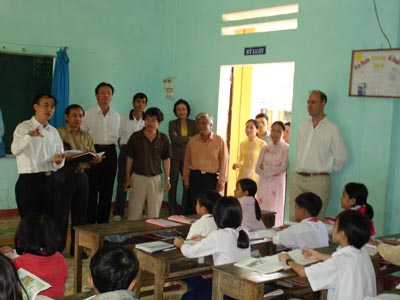 |
The Institute leadership together with WHO's experts supervising
the mass deworming campaign in a primary school of Quang Nam province |
Proposal to deal with blood-sucking bugs in humans
In 2010, kissing bugs were reported to occur in many localities across the country, which attracted the masses' special concerns and made the people worried about the risk of transmitting disease from these bugs. With the purpose of determining the reliability of this information to report to the MoH for direction, the IMPE-Quy Nhon conducted the investigation and surveillance in several provinces and cities of Central Vietnam such as Da Nang City, Quang Nam, Quang Ngai, Binh Dinh province on its own initiative and reported the MoH on the results of blood-sucking bugs in humans; it also proposed the ministerial-level scientific research project of "Biological characteristics, distribution and disease-transmitting ability of Triatoma spp. and effective control measures against kissing bugs in Vietnam" to clearly identify scpecies composition, biological habits, distribution and disease-transmitting ability of blood-sucking bugs as the basis for putting forward efficient control measures and to provide accurate scientific information on kissing-bugs and settle this matter of public interest satisfactorily.
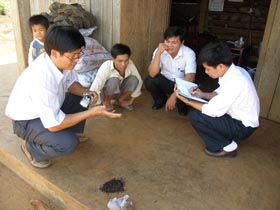 | 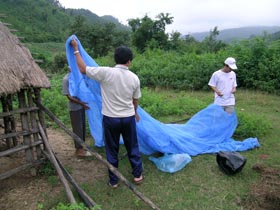 |
Staff of Entomology Department investigating
blood-sucking bugs at locality | Staff of Entomology Department in their field work. |
Medical examination and treatment at the Specialised Clinic of the Institute
Within five years (from 2005 to 2010), the Specialised Clinic of the Institute provided medical examinations for over 80,000 people, detection and treatment for nearly 150,000 fascioliasis cases and tens of thousands of cases of parasitic diseases such as toxocariasis, strongyloidiasis, gnathostomiasis, taeniasis, opisthorchiasis, amoebiasis, etc. With the principle of "First hospitality, then medical service", patients are always received warm welcome and given thoughful care by the Clinic staff; moreover, the services of the Clinic are improved, the diagnosis and lab-based examination of parasitic diseases give exact results and the therapeutic methods show their effectiveness. As a result, the Clinic has gradually been trusted and drawn increasing numbers of patients, becoming a brand name of the Institute in the specialised field. In order to satisfy the people's treatment demand, in 2010 the MoH decided to allow the increase in number of clinic beds to 50, facilitating wider medical examination and treatment of the Institute and laying the groundwork for upgrading the Clinic into Parasitic Specialised Hospital according to the MoH's direction.
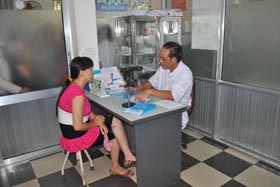 | 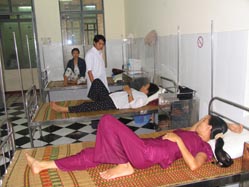 |
Medical examination at the Specialised Clinic | Patients treated at the Specialised Clinic |
Scientific research
In the past five years, the Institute conducted 11 ministerial-level projects, 44 institutional-level projects and 9 international cooperated projects pertaining to applied and basis scientific research. These projects were finished as scheduled and highly appreciated by the MoH and the Institute with 80 percentage of them achieved fairly good; furthermore, they can be effectively applied to reduction of disease morbidity and mortality, containment of epidemics and solution to real difficulties in epidemic control in Central Vietnam.
In the context of more challenges such as changeable malaria parasite formula and widespread malaria drug resistance, the studies for more effective treatment regimes for malaria and fascioliasis should not be only the solution to the problems, but also require the training of medical staff involved in malaria, other parasitic and vector-borne diseases in order to provide health services at the lowest levels and to control the diseases and outbreaks as well. Especially, in the period 2005-2010, the malaria infection tended to decrease but it was an unstable tendency and the risk of malaria outbreaks was high in the absence of feasible anti-malaria measures for mobilised populations; besides, there have not been any systematic evaluation of or large-scale control program for newly-emerged parasitic diseases. As a result, the contents of the Institutescientific studies have been mainly concentrated on finding effective interventional solutions to disease control as matter of priority; for examples, application of bed-net and hammock-net impregnation with insecticides to mobilised communities, effectiveness of distribution of arterakin to forest-sleepers for standby treatment, situation and effectiveness of anti-malarial drug management at all levels, developments of drug-resistant malaria parasites and efficacy of ACTs - artemisinin-based combination therapies. The Institute has also conducted basis research on major malaria vectors, especially applied molecular biological techniques such as PCR and electrophoresis (enzyme) to identify sub-species from two major Anopheles species of An.minimus and An.dirus, thereby comparing their distribution based on different habitats in the region and differentiate between species in complexes; studies on the distribution of Culicinae population and the biological habits of vectors of dengue (Aedes aegypti), Japanese encephalitis (Culextritaeniorhynchus) and lymphatic filariasis (Culex quiquefasciaticus); researches on epidemiology, diagnostic techniques and therapeutic experiment of Fascioliasis as the scientific basis of the MoH's guidelines on diagnosis and treament of human fascioliasis; study on helminthiasis infection and experiment with albendazole therapy, on decoding mitochondrial genome of Opisthorchis viverrini in Vietnam to compare with those in the world by molecular biological techniques.
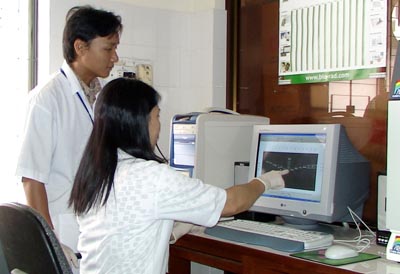 |
Identify mosquito species by molecular biological techniques |
Training
From 1978 to now, the Institute has trained 33 formal courses and 3 non-formal on second-level laboratory examinations, including an overall number of 1,308 graduated students. The Institute provides specialised staff for health systems at all levels, many of whom hold important positions in the local health services. Besides, the Institute organises re-training and intensive training courses for more than 130,000 medical staff from provincial and district levels. In addition, it coordinates with Hanoi Medical University, Tay Nguyen University, Hue Medical University, University of Science, Vietnam Military Medical University, Quy Nhon University and other research institutes to train graduates, masters and to metor for PhD and master theses.
In order to enhance the capacity of the Institute staff, the IMPE-Quy Nhon assigned the staff to participate in post-graduate training courses in domestic and foreign universities; besides, some of staff of the Institute were appointed to work at the Ministry of Health, the Central Institutes or work as consultants for the international health organizations. Nowadays, the IMPE-Quy Nhon had 1 Assoc.Prof., 5 Ph.Ds, 17 Masters, 1 MD level 1 specialization and 72 graduates to assume research activities and direct control measures of the epidemic in the central coastal and highland areas.
Health education and communication
The Institue has developed and issued healtheducation and communication curriculums for launching capaigns to change the awareness and behaviour of the people of all ethnics in the region. Health communication and education activities are carried out annually with appropriate measures such as the launching ceremony "World Malaria Day 25 April", the massive malaria control campaigns, "The Competition on knowledge and skills ofmalaria control for ethnic minorities", TV live talk shows on malaria control, direct communication at households, etc.
In another aspect, the Institute applied the information technology efftively to health sector such as Malaria Management Software (MMS), Medical Examination Management Software, LAN network, internal mail box (email), especially the Website of the Institute with more than 9 million hits, thereby popularizing the specialised information as well as the policies of the Party and the Government; being a useful health communication channel for the people not only in the country, but also the world. The Website was praised and rewarded the certificate of merit of MoH for applying the information technology excellently in 2008.
International cooperation
In the past 5 years, the Institute has participated in many international projects such as the Vietnam Global Fund Malaria Control Project, Anti-malaria Project for ethnic minorities, Control Project of infectious diseases for Greater Mekong Subregion; carried out lots of international cooperation projects highly effective in controlling malaria and parasitic diseases in Vietnam in collaboration with World Health Organization (WHO), Medical Committee Netherlands-Vietnam (MCNV), Sanya Tropical Medicine Research Institute (Guangzhou province, China), Australian Army Malaria Institute (AAMI), Clinical Research Unit-Oxford University, etc.
Besides, many Institute staff-members have been assigned to undertake overseas study tours, working missions, long-term trainings and attendance to international seminars and workshops in China, India, Australia, Thailand, Malaysia, Indonesia, Phillipines, etc. for the enhancement of study capacity, technical and specialised qualifications as well as application in epidemic control activities in Vietnam.
Management of Resources
Management of the Institute activities
The management of the Institute complies with the operational and democratic regulations, practises economy against wastefulness and conserves medical ethics; besides, ensures financial disclosure and annual financial audit. Especially, the Institute has implemented the Decree No.43/NÄ-CP on self-control and self-responsibility of health units since 2005 and the Decree No.115/NÄ-CP on self-control and self-responsibility of public technical and scientific organization; the leaders of the departments/offices and the affiliated units are assigned their tasks clearly with complete initiative in accomplishing them excellently. Furthermore, the Institute has made effection deployment of technical and scientific services, hence improving the Institute staff's income.
The IMPE-Quy Nhon has continuously developed the infrastructure facilities, research laboratories and working offices; especially, the Institute expanding construction project is in building process with modern equipment,responding to the requirements of a leading research institute. It has also strengthened the activities of the technical and scientific services, services of medical examination and treatment and vector-borne diseases control, contributing to the improvement and protection of public health.
The Institute has also effectively implemented the emulation movement of studying and following Ho Chi Minh's moral example (2007-2010) in connection with the behaviour regulations for medical staff and encouraged typical examples in the patriotic emulation movement.
Activities of Institute Communist Party and Unions
The Institute Communist Party plays the important role in political and ideological education for the members, brings into play the responsibility of the Party members and staff to develop the unit powerfully. With the leaderships of the Executive Committee of MoH’s Communist Party, the Communist Party of Quy Nhon city and the Communist Party of the Binh Dinh Provincial Organizations Block, the Institute Communist Party issued the regulations under the policies of the State and created the solidarity among the members.
The Institute Trade Union, the Women Union and the Ho Chi Minh Communist Youth Union are always enthusiastic in the emulation movements to mobilize the moral strength of overall staff. In addition, the Institute also organises travel tours for the staff, parties for the children on Children's Day or the Mid-Autumn Festival and participates in charitable activites such as, fund raising to support the poor, humanitarian blood donation, free examination and treatment for the poor, etc.
Cultural and sports activites
With the aims of encouraging the Institute staff to practise wholesome lifestyle and improve their health, the Institute usually organises and participates festival rallies, the music performance competition of health sector and others. As a result, the Institute staff has won many considerable achievements, promoting the spirit of exercising sports and music performance ebulliently in the Institute.
Achieved rewards of IMPE-Quy Nhon in 5 years (2005-2010)
In the past 5 years (2005-2010), IMPE-Quy Nhon always accomplished excellently its missions such as rolling back malaria, controlling dengue fever epidemic, decreasing rate of Fascioliasis and other helminthiasis; moreover, contributing actively to care and enhance health of the people. As a result, IMPE-Quy Nhon was presented noble rewards by the Communist Party of Vietnam, the Government of Vietnam, the Ministry of Health and other unionssuch as Honourable Name of Labour Hero (2007),2nd grade Independence Medal (2011), 3rd grade Independence Medal (2005), 1st grade Labour Medal (1997), 2nd grade Labour Medal (1985), 3rd grade Labour Medal (1981), 3rd grade Liberation Medal (1974) and dozens of emulation flags of the Government, the Ministry of Health and the Provincial People's Committee of Binh Dinh.
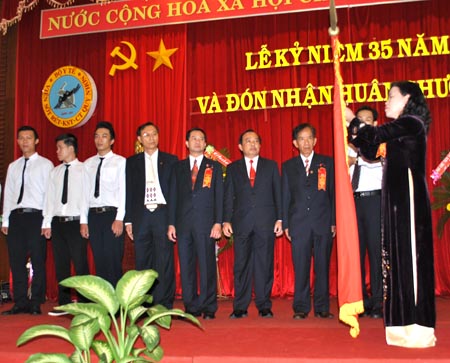 |
The 2nd grade Independence medal awarded to the Institute by the Ministry of Health |
During development process of the Institute, the international experts contributed greatly their efforts to the National Malaria Control Program in Vietnam. The Chinese experts contributed their efforts to the research and production of antimalarial drugs based combination therapy CV8, Dihydroartemisinine + Piperaquine (Artekin, Arterakin, CV-artecan); the Netherlander experts (Netherlands-Vietnam Medical Committee) researched bednets impregnated with insecticides Permethrine in hyper-endemic malaria areas; the experts of WHO and the Australian experts researched the situation of antimalarial resistance and the therapeutic efficacy of the current antimalarial drugs. With their great contributions, IMPE-Quy Nhon suggested the Communist Party of Vietnam, the Government of Vietnam, the Ministry of Health to award Friendship Medals and Memorial Medals for the international experts to memorize their achievements in the National Malaria Control Program in Vietnam.
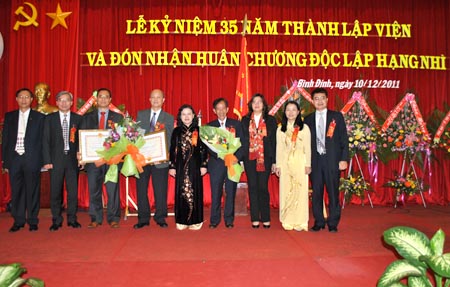 |
Prof. Li Guoqiao and pharmacist Song Ju Zong awarded Memorial Medals
"for the sake of the people's health" by the Ministry of Health |
The above achievements and merits are the indefatigable efforts from the leaders and the staff of IMPE-Quy Nhon to strive and accomplish their missions excellently.
Development orientation of the institute by 2020
Confronted with the increasing burden of the diseases, the top priority of the IMPE-Quy Nhon from now to 2020 is to continue to roll back malaria, to contain the increase of fascioliasis and other newly-emerging and emerging parasitic diseases, prevent the development of dengue fever and lymphatic filariasis, direct control measures of parasitic and vector-borne diseases to accomplish the overall functions and duties assigned by the Ministry of Health.
The Institute will develop and apply health communication and education measures for controlling malaria, parasitic and vector-borne diseases in the community. Also, it will strengthen the directions and inspections on the epidemic diseases at the most severely-hit areas in order to detect, treat and provide early warnings timely. Furthermore, malaria control measures will be attentively focussed on mobile people, people working in the forests, sleeping at the field huts and crossing the borders. Besides, evaluation of infectious parasitic and vector-borne diseases should be oriented to define their causes and epidemiological distributions; at the same time, effective control measures will be proposed. Last but not least, the Institute will organise training courses for specialised staff on knowledge and skills of controlling vector-borne diseases anddetecting and treating of fascioiasis at grass-root levels.
According to the general plan of the Institute until 2020, the Institute proposes the Ministry of Health to re-approve the regulations on organization and activities of the Institute in the new period; in addition, the Institute also enhances the ability of technical and scientific staff, expands the infrastructure and upgrades the equipment in respond to increasing needs of disease control activities in the Central region of Vietnam.  | Expanding construction project of IMPE-Quy Nhon |
Upgrading project of the specialised clinic of the Institute | 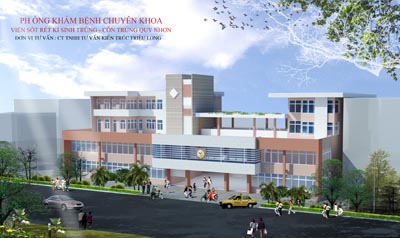 |
Bringing into play achieved results, all staff-members of the Institute with creative labour spirit, enthusiasm and devotion to their professional careers decidedly strive for the perfect accomplishment of assigned tasks and rollback of epidemic diseases in the community, contributing a worthy part to the people's health care and protection.