In September, the Central region not only faced the increasing malaria situation at severely-hit areas for 8 consecutive months, but had to deal with the risks of possible malaria outbreaks as a result of the Ketsana typhoon.
Malaria situation in September 2009 against the same period of 2008
- Malaria morbidity: The whole region reported a 23.91% higher in the number of malaria cases, including 10.06% higher in coastal area and 42.21% up in the West-highlands.
+ Ten out of 15 provinces had higher malaria morbidity, including: Quang Ngai (219.35%), Phu Yen (150.0%), Binh Thuan (144.0%), Gia Lai (142.68%), (Dak Lak 76.41%), Binh Dinh (53.13%), Dak Nong (21.49%), Quang Tri (12.31%), Ninh Thuan (8.43%), and Khanh Hoa (3.41%).
+ The remaining five provinces saw a reduced malaria morbidity, i.e Kon Tum (55.44%), Da Nang city (40.00%), Quang Nam (17.65%), TT-Hue (16.67%), and Quang Binh (15.18%).
- Malaria parasite rate: The region had a rate of 75.91% up, composed by higher rates of 48.50% and 152.49% in the coastal area and the West-highlands, respectively.
+ Nearly all provinces (14/15) with higher malaria parasite rates included Quang Ngai (3084.5%), Phu Yen (261.21%), Binh Thuan (221.29%), Dak Lak (203.33%), Gia Lai (150.92%), Binh Dinh (129.96%), Dac Nong (92.68%), TT-Hue (68.23%), Quang Binh (44.27%), Khanh Hoa (43.63%), Ninh Thuan (31.54%), Quang Tri (17.87%), Kon Tum (11.01%), and Quang Nam (4.01%)
+ Only one province (Danang city) had 25.0% lower parasite rate.
- Severe and complicated malaria: ten cases were reported, increasing 4 cases or 66.67% compared with the same period. Five provinces with severe and complicated cases were: Gia Lai (5 cases), Quang Binh (2 cases), Quang Tri, Khanh Hoa, and Ninh Thuan one case each.
- Malaria mortality: Similar to the same period of 2008, there were 2 deaths from malaria, shared by Quang Tri and Gia Lai provinces.
Malaria situation in 9 first months of 2009 against the same period of 2008
- Malaria morbidity: The whole region reported a 12.00% higher in the number of malaria cases, including 4.5% higher in coastal area and 23.56% up in the West-highlands.
+ Over half of the regional provinces had higher malaria morbidity, including: Binh Thuan (84%), Gia Lai (80%), Phu Yen (46.35%), Dak Lak (23.41%), Quang Tri (21.78%), Binh Dinh (6.40%), Quang Nam (5.77%), and Ninh Thuan (1.7%);
+ The remaining seven provinces saw a reduced malaria morbidity, including Danang city (25.00%), Quang Binh (15.07%), Quang Ngai (14.47%), TT-Hue (13.98%), Kon Tum (11.50%), Khanh Hoa (1.89%), and Dak Nong (1.21%).
- Malaria parasite rate: The region had a rate of 50.59% higher, of which coastal provinces had 35.2% higher and the West-highlands saw a 89.29% higher.
+ Most of the provinces (12/15) with higher malaria parasite rates included Quang Ngai (221.57%), Gia Lai (152.76%), Dak Lak (118.36%), Binh Thuan (112.39%), Khanh Hoa (86.21%), Binh Dinh (71.84%), Phu Yen (63.83%), Quang Nam (38.49%), Ninh Thuan (21.20%), Kon Tum (18.41%), Dak Nong (10.58%), and Quang Tri (7.53%);
+ Three remaining provinces with lower parasite rates, including Danang city (40.57%), Quang Binh (22.74%), and TT-Hue.
- Severe and complicated malaria: there were a total of 66 cases reported, 21 cases or 46.67% higher compared with last year's period. These cases were contributed by Ninh Thuan (22 cases), Gia Lai (10 cases), Dak Lak (8 cases), Quang Binh (6 cases), Phu Yen (6 cases), Kon Tum (5 cases), Quang Tri (4 cases), Khanh Hoa (3 cases), Quang Ngai and Dak Nong one case each.
- Malaria mortality: There were 9 deaths from malaria, 4 cases (80%) higher against the same period, including 2 cases in Gia Lai, 1 case each in the following provinces of Quang Binh, Quang Tri, Phu Yen, Ninh Thuan, Kon Tum, Dak Lak, and Dak Nong.
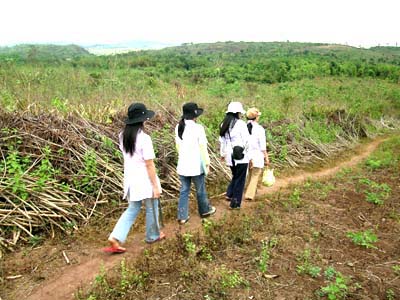 |
Health workers on the way to far-and-remote villages. |
Interpretations of increasing malaria situation
- According to the statistics by the IMPE-QN, in September and the first 9 months of 2009, the morbidity cases increased, both in the numbers of clinical and positive cases. Particularly, there were 9 deaths from the disease, 4 cases higher than the same period of 2008. In some areas, the parasite rates raised 100% and the positive case increased by 200%, mainly concentrated in the mobilised population (forest workers, free immigrants, border-crossing objects or seasonal workers in malaria endemic areas). September has been the 8th consecutive month which malaria morbidity has been increased in the whole region, and the increase has levelled up with complicated developments by the end of the month for the provinces just experienced the devastations of the Ketsana typhoon, which wiped out all protective purposes from the last carried out campaigns of malaria control measures (residual spraying and bednet impregnation). Until now, some areas have been isolated with malaria patients being out of control, leading to high risk ofmalaria outbreaks for the remaining months of the year.
- The data obtained from epidemiological surveys under the Global Fund Project, and from the National Malaria Control Project in provinces also found a higher number of malaria cases and malaria vectors at some endemic areas such as Son Tay district (Quang Ngai), Dong Xuan (Phu Yen), Huong Hoa and Dak Rong (Quang Tri), Bac Binh (Binh Thuan), Chu Se, Ia Grai and Krong Pa (Gia Lai), Ea H'Leo and Cu M'Nga (Dak Lak). It is predicted that the malaria situation will be complicated, urging the IMPE and provinces in the region to apply more active measures to timely control increasing malaria situation, to minimize complicated cases or deaths from malaria, and to prevent malaria outbreaks from happening.
Fascioliasis and other intestinal parasitic diseases
Fascioliasis
- In September, of 2,328 people coming to the IMPE's Clinic for medical examination, there were 199 (or 8.55%) cases of fascioliasis detected and treated, mainly from Binh Dinh and Phu Yen provinces. In addition, there were 61 cases (2.6%) of other parasitic diseases such as Strongiloides stercoralis, Toxocara canis/ascaris, and Gnathostoma stercoralis.
- Since the beginning of 2009, fascioliasis patients increased excessively in the Central region of Vietnam. In the first nine months of 2009, there were 1,787 patients admitted at the IMPE's Clinic, much higher than the numbers of patients in 2007 and 2008.
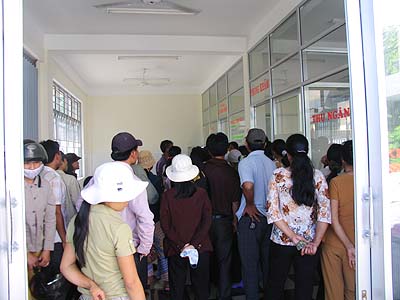 |
Over the past 9 months, there were 1,767 fascioliasis patients admitted
and treated at the IMPE's Clinic, accounting for 11.58% of
the total patients coming to the clinic |
- Confronting the increasing number of fascioliasis patients and the shortage of the specific drugs Triclabendazole (Egaten 250 mg), the IMPE-QN sent report to the MoH and requested for taking the initiative of buying the specific drug under the guidelines and regiments by the MoH. In the first attempt, the IMPE-QN was granted the tender for the purchase of 12,000 Egaten tablets to meet the earnest needs of the patients at the IMPE's Clinic, but also to supply the provinces in need with the original prices. More importantly, the IMPE-QN is setting up the community-based fascioliasis control project in order to protect and improve the people's health in the region.
Other parasitic diseases
Beside fascioliasis, other parasitic diseases are becoming a major burden to public health such as opisthorchiasis, schistosomiasis, fasciola hepatica/gigantica, Strongiloides stercoralis, Toxocara canis/ascaris, and Gnathostoma stercoralis and other soil-transmitted parasites.
With the regularly funding supports from the MoH and the donored drugs from the WHO, the IMPE-QN strengthened the epidemiological surveillance to identify the areas for effective interventions. The IMPE-QN carried out the mass deworming campaign for primary school children, the health education and communication as well as the deployment of detection and treatment of parasitic diseases at the community.
Main activities of IMPE-QN in September 2009
Line steering
- In order to overcome the damages caused by the Ketsana typhoon, the IMPE leadership paid direct trips to localities of TT-Hue, Quang Nam, Quang Ngai, Kon Tum and Gia Lai to investigate the calamities, and therefore to provide those provinces the materials, chemicals and equipment with an aim of preventing malaria outbreaks spreading afterwards.
- Made a request to the provincial malaria centres/provincial medical prevention centres for strengthening malaria depidemiological surveillance, management and treatment of malaria cases, deployment of malaria vector control measures at severely-hit areas of the disease.
- Sent working groups of carry out epidemiological surveillance, malaria diagnosis and treatment and malaria vector investigation under the assigned workplan by the Global Fund, the National Malaria Control Project and the National Helminthiasis Control Project in the provinces of Quang Ngai, Khanh Hoa, TT-Hue, Quang Tri, Quang Binh, Ninh Thuan and Gia Lai.
- Coordinated with the Nha Trang Pasteur Institute and the Tay Nguyen Institute of Hygiene and Epidemiology to implement the dengue fever control project in the region.
- Supervised and provide directions in terms of management, operations and implementation of activities under the Global Fund project in Dak Nong and Khanh Hoa provinces; cooperate with Chu Se Rubber Cooperation to set up the malaria control plan for rubber workers in Cambodia.
International cooperations, scientific research, training and information technology
- Continued the coordinative studies with other counterparts in the field, and studies of ministry and IMPE's levels. Seek for the supports of the WHO office in Vietnam and the WHO West Pacific office for fascioliasis control study in a highly infected province of the region.
- Organised the graduation examination for the laboratory medical technicians course 30 and opening ceremony for the students of course 32.
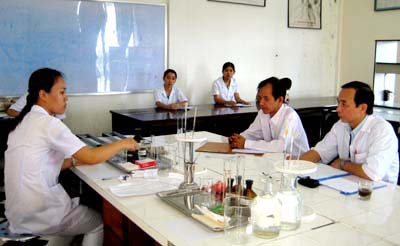 |
Graduation examinations for medical laboratory technical students
course 30, former-training form |
- Organised two training workshop on malaria management for district health staff under the Global Fund Project; and the competition on knowledge of malaria control for the ethnic minorities in Dak Nong province.
- Sent specialist to participate in the Scientific Workshop at the Institute of Ecology and Biological Resources.
- Held the Mid-Autumn festival for IMPE staff's children.
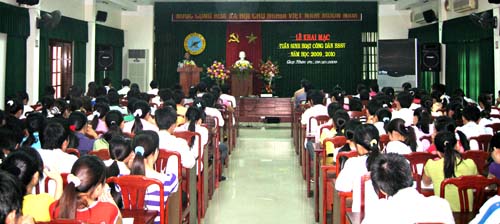 |
Organising the Civics Week activities for pre-course and post-course medical technical students. |
Home management
- Worked with the MoH on the project of expanding the IMPE facility, and finished the initial work such as reimbursement for land clearance; organised visiting trip for laboratory staff to medical laboratories in Hochiminh City to plan for new working facilities.
- Opened the bidding packacges of drugs, chemicals and equipment from the budgets of regular national spendings and the national malaria control project. Completed and sold the bidding documents for construction of storage 19.
- Deployed the Unit of flood and storm prevention and control to protect the IMPE assets and to support the most-damaged localities.
Focus of activities in October, 2009
Speficic fields
- As for the serious damages caused by the Ketsana typhoon, outreaching the IMPE's capacity in terms of supports, the IMPE is asking the MoH for funding to control malaria in affected localities.
- Deploy the malaria epidemiological stratification for intervention in 15 Central provinces; direct provincial malaria centres/provincial medical prevention centres to strengthen malaria surveillance, treatment and management of malaria cases, vector control, provision of antimalarials for high-risk goups.
- Implement the second round of malaria epidemiological surveillance under the coverage of the Global Fund.
- Carry out the supervision in terms of management, operations and implementation of activities under the Global Fund project in Quang Tri, TT-Hue; participate in the malaria workshop along the borderline to be held by these two provinces.
International cooperations, scientific research, training and information technology
- Continue the coordinative research studies with national and international counterparts.
- Organise the civics week for pre-course and end-of-course medical technical students.
- Coordinate with the National Institute of Malariology-Parasitology and Entomology (NIMPE) to hold the "Training Course on Malaria Epidemiological Stratification for Intervention in Vietnam 2009."
- Organisethe training workshops on malaria management for district health staff under the Global Fund Project; hold the training course on field-based epidemiology under the VIHIP project.
Home management
- Make announcements for provinces affected by the Ketsana typhoon to enumerate damages for receiving supports from the MoH.
- Receive and allocate additional sources of drugs, chemicals, bednets, microscopes from the NIMPE to the severely-hit provinces of Quang Binh, Quang Tri, TT-Hue, Quang Nam, Quang Ngai, Kon Tum and Gia Lai.
- On the basis of the new structure and capacity, plan for construction of the expanded IMPE facility in line with the progress of the project.
- Deploy the plan for strengthening the organisation and operations of the IMPE as promulgated by the Government's Decree No.115/2005/ND-CP, approved by the MoH .
- Organise the meeting, talks and music performance on the 79th anniversary of the "Vietnam Women's Association (1930-2009)".
 |
A music performance on the 79th anniversary of the "Vietnam Women's Association (1930-2009)". |