Malaria situation of Central Vietnam in July 2010 against the same period of 2009
Malaria morbidity
Malaria morbidiy in the whole region, as compared with the same period of 2009, decreased by 4.03%, with the Central Coastal area 25.06% higher, the West Highlands 46.06% lower.
5 over 15 provinces had higher malaria morbidity, including Quang Nam (562.39%), Da Nang (400%), Quang Ngai (33.33%), Khanh Hoa (2.86%) and Phu Yen (2.27%).
10 over 15 provinces had lower malaria morbidity, including Thua Thien-Hue (-80.95%), Gia Lai (-61.88%), Binh Thuan (-59.76%), Binh Dinh (-54.84%), Quang Tri (-50.22%), Dak Nong (50.00%), Dak Lak (-37.68%), Quang Binh (-32.64%), Ninh Thuan (-29.38%) and Kon Tum (-16.44%).
Malaria parasites
The malaria parasite rates in the whole region, as compares with the same period of 2009, increased by 19.39%, with the Central Coastal area 56.39% up, the West Highlands 40.65% lower.
5 over 15 provinces with increased rates of malaria parasites included Quang Nam (493.5%), Kon Tum (346.14%), Quang Ngai (302.12%), Da Nang (2009: 0 case, 2010: 5 cases) and Khanh Hoa (10.11%).
10 over 15 provinces with decreased rates of malaria parasites included Thua Thien-Hue (-78.47%), Quang Tri (-76.42%), Gia Lai (-65.91%), Quang Binh (-61.11%), Dak Nong (-55.91%), Dak Lak (-40.06%), Binh Dinh (-35.98%), Binh Thuan (-7.98%), Ninh Thuan (-5.33%) and Phu Yen (-3.60%).
Severe and complicated malaria
The whole region had 11 severe malaria cases, increasing by 37.5% compared with the same period of 2009, including Ninh Thuan 4, Quang Ngai 4, Quang Tri, Dak Lak and Quang Nam one case each.
Malaria death
In July 2010, the whole region had no death from malaria.
Malaria situation of Central Vietnam in August 2010 against the same period of 2009
Malaria morbidity
The whole region reported a 16.49% (1,940/2,323) lower in the number of malaria cases including the Central Coastal area 42.37% lower and the West Highlands 4.78% down.
3 over 15 provinces with increased rates of malaria cases included Quang Nam (201.27%), Quang Ngai (82.35%), Da Nang (50%)
11 over 15 provinces with decreased rates of malaria patients included Quang Tri (-59.77%), Gia Lai (-55.12%), Thua Thien-Hue (-38.30%), Kon Tum (-35.67%), Dak Lak (-35.32%), Phu Yen (-34.07%), Quang Binh (-25.56%), Binh Dinh (-24.14%), Dak Nong (-17.19%), Binh Thuan (-2.07%), Khanh Hoa (-1.67%).
Malaria Parasites
The malaria parasite rates in the whole region, as compared with the same period of 2009, decreased by 25.01%, with the Central Coastal area 0.25% higher, the West Highlands 55.18% lower.
4 over 15 provinces with increased rates of malaria parasites included Quang Nam (339.03%), Quang Ngai (264.79%), Da Nang (52.68%) and Binh Thuan (112.39%).
11 over 15 provinces with decreased rates of malaria parasites included Quang Tri (-78.01%), Khanh Hoa (-61.01%), Gia Lai (-59.77%), Phu Yen (-55.80%), Quang Binh (-55.27%), Dak Lak (-44.13%), Kon Tum (-41.27%), Thua Thien-Hue (-36.01%), Binh Dinh (-25.89%), Dak Nong (-25.16%) and Ninh Thuan (-18.05%).
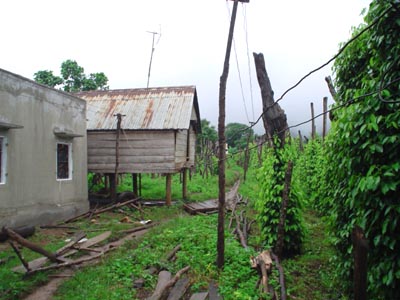 |
Malaria habitat. |
Severe and complicated malaria
The whole region had 6 severe malaria cases, decreasing by 40% compared with the same period of 2009, including Ninh Thuan 2, Phu Yen, Khanh Hoa, Dak Lak and Binh Thuan one case each.
Malaria death
In August 2010, the whole region had 1 death from malaria.
Evaluation of malaria situation in July and August of 2010
In July 2010, although the malaria morbidity of the whole region tended to reduce, in some provinces it still increased drastically such as Quang Nam, Quang Ngai. High malaria morbidity rates were mainly due to mobilised people (people working in the forest, sleeping in the field huts and crossing the borders). The raise of malaria-causing agent (malaria parasites) in malaria-endemic areas was in association with the appearance of malaria main vectors (i.e An.minimus and An.dirus), so the risks of malaria transmission could increase complicatedly in next months.
In August 2010, rates of malaria morbidity and parasite of the whole region tended to decrease because malaria control measures such as residual insecticidal spraying, epidemiological surveillance for severely-hit areas were strengthened. However, rates of malaria morbidity and parasite still increased highly in Quang Ngai and Quang Nam and the decrease of malaria indices showed unstable, so health centres needed to strengthen control measures and epidemiological surveillance in border areas and areas of mobilised people.
The situation of Fascioliasis and other helminthiasis
In July 2010, there were totally 6,568 patients coming to seek diagnosis and treatment at the clinic. Among the patients, 61 cases were treated with Fascioliasis, accounting for 0.93%, the remaing patients were diagnosised and treated with other common helminthiasis such as Toxoplasmosis, Strongyloides stercoralis, Taenia solium, Gnathostoma stercoralis.
In August 2010, there were totally 6,638 patients coming to seek diagnosis and treatment at the clinic. Among the patients, 30 cases were treated with Fascioliasis, making up 0.45%, the remaining patients were diagnosised and treated with other common helminthiasis such as Toxoplasmosis, Strongyloides stercoralis, Taenia solium, Gnathostoma stercoralis.
Main activities of IMPE-QN in July and August, 2010
Line steering
Directed the provinces to strengthen epidemiological surveillance, prevent the outbreak of malaria and reduce rate of death from malaria for mobilised people; monitored activities of residual insecticidal spraying, bednet impregnation; carried out malaria control measures effectively to prevent the increase of malaria morbidity, decrease rates of severe and complicated malaria and death for high-risk groups.
The Institute's leaderships had the meeting with steering committee of malaria control programme, unified the plan for malaria epidemiological stratification and participated the workshop on malaria control of the Northern areas in Ha Tinh province and the workshop on malaria control of the Southern areas in Ho Chi Minh city.
Carried out the operational plan of national programme on malaria control and Vietnam Global Fund Malaria Control Project; deployed dengue fever control in Binh Dinh and Phu Yen province; organised surveillance mission to monitor blood-sucking bug situation in Da Nang.
International cooperations, scientific research and training
Deployed the plan of executing the ministerial and Institute level projects; continued the coordinative studies with other counterparts in the field of malaria, dengue fever and parasitic diseases.
Organised the graduation examination for the laboratory medical technicians course 31 and opening ceremony for the students of course 33.
Laboratory medical technicians course 31 in their graduation examination. |
Sent staff to participate in the "Training Course on Field Epidemiology" organised by the Department of Preventive Medicine at Institute of Hygiene and Epidemiology Tay Nguyen.
Worked with the Belgian experts on Fascioliasis control project; sent the report on the activities of the Institute in first half of 2010.
Held the meeting to evaluate and build the studies on information technology and blood-sucking bug; participated the workshop on dengue fever in Nha Trang city, Khanh Hoa province.