In January and February of the previuos years, malaria cases of Central Vietnam often tends to be lower than the peak of malaria transmission season (from March to May, September to November); however, according to the statictical figures of the IMPE Quy Nhon, right in January 2010 all the malaria indexes (malaria patient, malaria parasite, severe malaria) raise highly compared with the same period of previous years. Thus, this is the reason to warn the risk of malaria return, even malaria outbreaks on a large scale.
Malaria situation in Central Vietnam in January 2010 against the same period of 2009
Malaria patients
Malaria morbidity in the whole region, as compared with the same period of 2009, increased by 42.69% (1,454/1,019 cases), with the Central Coastal area 535.55% higher (755/557), the West Highlands 51.30% up (699/462).
13/15 provinces had higher malaria morbidity, including Da Nang (200%), Binh Dinh (185.71%), Quang Nam (133.87%), Thua -Thien Hue (66.67%), Dak Lak (66.36%), Phu Yen (65.63%), Dak Nong (59.78%), Gia Lai (55.23%), Khanh Hoa (48.82%), Kon Tum (17.58%), Quang Tri (9.84%), Binh Thuan (4.92%) and Ninh Thuan (3.23%).
- 2/15 provinces had lower malaria morbidity, including Quang Ngai (- 28.57%), Quang Binh (- 5.56%).
Malaria parasites
In January 2010, the malaria parasite rates in the whole region, as compared with the same period of 2009, increased by 81.72%, with the Central Coastal area 107.78% higher, the West Highlands 55.82% up.
- 13/15 provinces with increased rates of malaria parasites included Quang Nam (325.33%), Binh Dinh (312.91%), Phu Yen (186.05%), Dak Lak (110.78%), Dak Nong (107.48%), Da Nang (100%), Kon Tum (89.15%), Binh Thuan (87.83%), Khanh Hoa (83.73%), Gia Lai (16.84%), Thua Thien Hue (12.16%), Quang Tri (2.42%) and Ninh Thuan (1.26%).
- 2/15 provinces with decreased rates of malaria parasites included Quang Binh (- 60.17%), Quang Ngai (- 43.27%).
Severve and complicated malaria
There were 12 cases reported, increasing 140% (12/5) compared with the same period of last year, with the West Highlands 500% higher (12/2), including Dak Lak 5, Dak Nong 4, Gia Lai 2 and Kon Tum 1.
Malaria death
In January 2010, , the whole region had no death from malaria.
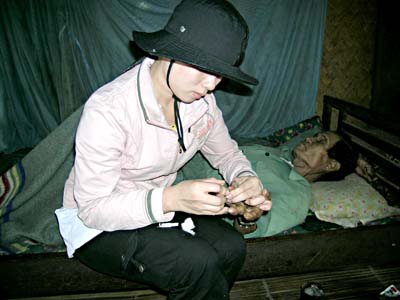 |
An health staff taking blood slides for malaria detection. |
Evaluation of the increased malaria situation
The above data showed that all the malaria indexes of the Central Vietnam increased in January 2010, which coincided with the prediction of the IMPE Quy Nhon and the Department of Preventive Medicine and Environment (MoH). It should be noted that in provinces with increased malaria indexes, there are a simultaneous raise of both malaria morbidity and parasites. The increase of malaria-causing agent (malaria parasites) in malaria-endemic zones where the malaria main vectors (i.e An.minimus, An.dirus) have been in existence is really worrying because the risks of malaria transmission could be at high, showing that malaria situation in Central Vietnam is still not unstable with high risks of outbreaks.
High malaria morbidity rates were mainly due to imported cases crossing the borders, such as the Vietnamese-Laotian border (Quang Tri province). Some cases in Gia Lai, Kon Tum, Dak Lak, Dak Nong, Quang Nam, Binh Dinh were reported by working in the forests, sleeping in the field huts, and upon returning from forests they were infected with malaria. Although malaria situation tended to increase compared with that of last year, it was not out of control of localities, which actively conducted intensively control measures (eg. residual insecticidal spraying, additional bednet impregnation, and management and treatment of malaria patients) together with malaria epidemiological surveillance in severely-hit areas for timely detection and control.
The malaria situation in January 2010 in the whole region of Central Vietnam continued increasing like that of 2009 was the reason to forecast the continous increase of malaria situation in the remaining months of 2010, especially in the peak of malaria transmission season (from March to May, September to November). Provinces are suggested to be prompt to carry out effectively and timely malaria control measures, which firstly are of the malaria control campaign stage I/2010, so as to finish the defined target and plan; more importantly to lower the disease morbidity/mortality and prevent the outbreaks from occuring in the target areas.