From January 2009 to June 2010, malaria indexes continuously increased; until July 2010, malaria hotspots in Central Vietnam was temporarily controlled. This can be considered as the initial efforts of health branches of the regional provinces and cities to roll back malaria. However, it is just a interim result because from now to the end of this year, Central Vietnam is coming into rainy season, which is also the peak season of malaria transmission.
According to the statistics of malaria situation in July 2010 of the Institute of Malariology Parasitology and Entomology Quy Nhon in comparison with the same period of last year:
Malaria patients in the whole region reduced by 4.03%, with the West Highlands 46.06% lower and the Central Coastal area 25.06% higher; 10 over 15 provinces had higher malaria morbidity, including Thua Thien-Hue (-80.95%), Gia Lai (-61.88%), Binh Thuan (-59.76%), Binh Dinh (-54.84%), Quang Tri (-50.22%), Dak Nong (-50%), Dak Lak (-37.68%), Quang Binh (-32.64%), Ninh Thuan (-29.38%) and Kon Tum (-16:44%), only 5 over 15 provinces had lower malaria morbidity, including Quang Nam (+ 562.39%), Da Nang (+ 400%), Quang Ngai (+ 33.33%), Khanh Hoa (+ 2.86%) and Phu Yen (+ 27.2%).
The whole region reported a 19.39% higher in the rate of malaria parasites, including the West Highlands 40.65% lower and the Central Coastal area 56.39% up; 10 over 15 provinces with decreased rates of malaria parasites includedThua Thien-Hue (78.47%), Quang Tri (- 76.42%), Gia Lai (- 65.91%), Quang Binh (- 61.11%), Dak Nong (- 55.91%), Dak Lak (-40.06%), Binh Dinh (-35.98%), Ninh Thuan (-15.33%), Binh Thuan (-7.98%) and Phu Yen (-3.60%), just 5 over 15 provinces with increased rates of malaria parasites included Quang Nam (+ 493.50%), Kon Tum (+ 346.14%), Quang Ngai (+ 302.12%), Khanh Hoa (+ 10.11%) and Da Nang with slight raise of nonative parasites.
Severve and complicated malaria cases in the whole region increased by 37.50%, with the West Highlands 50% lower and the Central Coastal area 66.67% higher. There was no death from malaria while this number was 3 in the same period of 2009.
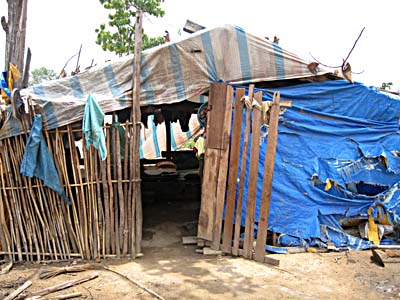 |
A common temporary house of ethnic minority in Central Vietnam. |
The above data shows that the malaria situation of Central Vietnam has been significantly improved, especially in the provinces of West Highlands (Gia Lai, Dak Lak, Dak Nong, Kon Tum). Previously, malaria cases and parasites of several provinces of Central Coastal area were in serious increase, but until July 2010 both these indices fell markedly, particularly in the provinces of Binh Dinh, Phu Yen, Binh Thuan, Quang Binh, Quang Tri, Khanh Hoa, etc.
In the few provinces with increased malaria indexes, Quang Nam is the most worrying province because of very high and prolonged malaria morbidity in many consecutive months.With the raise of malaria patients (+ 562.39%) and malaria parasites (+ 493.50%) (primarily due to disease spread in place) along with the high number of severve and complicated malaria cases (accounts for 40%), it is likely to occur outbreaks and malaria deaths in Quang Nam by the end of the year. In this province, the increase of malaria patients mostly happened in communes of Tra Don and Tra Leng (Nam Tra My district (640/80)), Tra Giac (Bac Tra My district) in both adult and children; Phuoc Loc and Phuoc Thanh (Phuoc Son district (80/4), where attract labour nationwide to come to dig and sift for gold). The malaria morbidity of Kon Tum and Quang Ngai provinces reduced, but the rate of malaria parasites augmented; this probably resulted from many households' bed-nets being swept away by the flood waters in 2009.
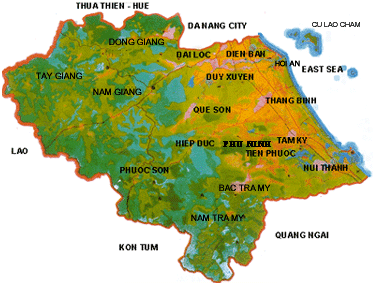 |
Political map of Quang Nam province. |
Although malaria indices in Central Vietnam tended to decrease in July 2010, this region has been still in the risk of malaria outbreaks because it has never had the reduction of malaria in a sustainable manner, especially as the rainy season and malaria transmission season drawing near. The best solution in the coming time is to strengthen epidemiological surveillance of malaria severely-hit areas, improve the quality of insecticide-residual spraying and bed-net impregnation, enhance the management, early detection and timely treatment of malaria patients; with at-risk provinces of malaria outbreaks like Quang Nam, it is necessary to prepare supplementary malaria control measures and focus resources to stamp out malaria in the hotspots.