Malaria situation in the first 6 months of 2009 against the same period of 2008
Malaria situation
Malaria cases of the whole region increased by 6.37% (7,895/7,422) compared with the same period of 2008, including the Central Coastal area (+4.95%), and the West Central Highland (+8.04%).
7 over 15 provinces with increased malaria morbidity included Quang Tri(+73.67%), Binh Thuan (+64.22%), Gia Lai (+32.64%), Phu Yen (+15%), Quang Nam(+14.99%), Ninh Thuan (+11.25), Dak Lak (+4.10%);
8 remaining provinces with decreased malaria cases included Quang Ngai (-43.72%), Thua Thien-Hue (-26.29%), Quang Binh (-22.71%), Binh Dinh (-20.74%), Da Nang City (-6.25%), Khanh Hoa (-3.61%), Dak Nong (-2.28%), Kon Tum (-0.94%).
Malaria parasite
Malaria parasites of the whole region increased by 49.34% (0.67/0.45) compared with the same period of 2008, with the Central Coastal area +53.75% higher, and the West Highlands +42.90% up.
11 out of 15 provinces with increased rate of malaria parasite included Gia Lai (+106.55%), Khanh Hoa (+100.06%), Binh Thuan (+81.26%), Quang Nam (+73.22%), Dak Lak (+57.57%), Ninh Thuan (+47.13%), Quang Tri (+46.09%), Binh Dinh (+31.89%), Kon Tum (+18.73%), Quang Ngai (+15.11%) and Phu Yen (+2.67%)
4 remaining provinces with decreased rate of malaria parasite included Quang Binh (-22.71), Da Nang City (-20.79%), Thua Thien Hue (-17.59%) and Dak Nong (-7.54%)
Severe and complicated malaria
37 severe cases were reported, 10 cases more than those of the same period of 2008 (37/27), of which the Central coastal area had 3 more cases (21/18) and the West Highlands 7 more cases (16/9).
The provinces with highly-increased severe and complicated malaria cases included Ninh Thuan (15/8), Gia Lai (5/1), Kon Tum (4/1) and Dak Lak (6/4).
Malaria death
The whole region had 3 malaria deaths reported in Gia Lai (1), Dak Nong (1) and Ninh Thuan (1), increasing 2 cases against the same period of 2008 (3/1)
Those 3 deaths were all admitted too late (2-7 days after falling ill), becoming serious complicated and died before 24 hours.
Malaria outbreaks : not occur
Compared with the same period of last year, the morbidity rate in the first half of 2009 increased by 6.37%; and deaths from malaria raised 2 cases compared with the given target. The provinces with increased malaria patients and malaria parasite rates included Quang Tri, Gia Lai, Dak Lak, Dak Nong, Quang Nam, Khanh Hoa, and Ninh Thuan; mainly among population movements, which were out of the control of the health sector. Therefore, the risk of malaria outbreaks in these areas in the end months of 2009 are at very high.
ADMINISTRATVE MAP OF COASTAL AND HIGHLAND PROVINCES OF CENTRAL VIETNAM |
The cause of increasing malaria patients and malaria deaths
Subjective cause
People have no awareness of self-protection as living in the highly-endemic malaria areas, especially the low rate of bed-nets usage paving favourable conditions for natural trasmission on the large geographical area at the peak of transmission season.
The termination of malaria transmission along the Laotian-Vietnamese border isn't likely to be carried out, especially for children under 15 years old, local people entering Laos to till and sleep in the field huts for a long time (included Laotian people crossing to the locality); moreover, Laotian community aren't protected against malaria, the cooperation from the Laotian side in malaria control seems not active, the control of illegal border crossing meets a lot of difficulties.
The provision of stand-by treatment is not still effective while the malaria main vectors (An minimus, An dirus) tend to recover and the positive cases always make up a considerable resevoir of malaria in the community.
Health facilities at grassroots level were unable to detect early and treat promptly malaria cases, or provide emergency aid for severe malaria cases; coupled with the fact that patients didn't go to health centers for medical examination and treatment.
Objective cause
Remote, deep-lying and border areas of Central Vietnam are all highly-endemic malaria ones with complex malaria epidemiological characteristics that are favourable for the natural transmission of malaria.
There are no feasible malaria control measures for mobilised population (people going to work in the forests and sleeping in the field huts, free migrants, and those crossing the borders), there are no active cooperation among neighboring countries in controlling border malaria.
Although the treatment were so much in accordance with the guidlines, in recent years, the shortage of Primaquine could affect the prevention of malaria transmission due to P.falciparum as well as the recrudescence due to P.vivax.
The varying weather created favourable environment for the development of vectors; besides, it is necessary to mention the cycle of malaria outbreak return from 3 to 5 year after the decreasing period of malaria cases.
Evaluation of malaria control activities in the first 6 months of 2009
Steering Guidance
In the context of the increasing situation of malaria in severely-hit areas, right in the early 2009, IMPE Quy Nhon sent many urgent documents to health departments, malaria control/health preventive centers and provincial hospitals in order to warn malaria risks andstrengthen guidelines for malaria control measures at localities; at the same time the Institute's leadership and concerned deparments directly steered malaria control at the provinces of Gia Lai, Kon Tum, Dak Lak, Dak Nong, Quang Binh, Quang Tri, Thua Thien Hue, Quang nam, Quang Ngai, Binh Dinh, Phu Yen, Khang Hoa, Ninh Thuan, Binh Thuan. Particularly, the Institute coordinated with Quang Tri province in clarifying the cause of malaria increase in Xy commune, Huong Hoa border district and applying intervention methods to prevent malaria outbreaks.
Executing the Institute's guidances, provincial leadership timely announced the districts to strengthen antimalarial measures, to provide supplementary intervention methods at high-risk zones of malaria such as mobilised population, border, deep-lying and remote areas; executive committees of the party hierarchy and all levels of local government continued caring about and steering malaria control properly, especially in severly-hit areas.
Malaria control networks also attached special importance to enhancing the quality of technical measures in the antimalarial campaigns and actively control mobilised malaria areas (areas with free migrants, people going to work in the forests and sleeping in the field huts and those crossing the borders); health network at grassroots levels (health facilities of districts, communes, hamlets, villages, microscopic points) actively participated in malaria control activities; however the detection, early treatment and malaria patient management at grassroots level remained a lot of difficulties, especcially at the Laotian-Vietnamese border area belonging to Quang Tri province due to no border cooperation in malaria control.
Malaria epidemiological supervision and epidemic control
The Institute has coordinated with the provinces in the region to arrange many malaria epidemiological supervision missions to severely-hit and highly-endemic malaria areas in order to evaluate malaria situation, propose solutions and control the risks of increasing malaria.
The Institute has improved the quality of malaria control measures and given supplementary methods such as residual spraying, bed-nets impregnation and treatment in high risk of malaria outbreaks; epidemiological monitoring activities in severely-hit areas and briefing conferences between communes, districts and provinces were continuously maintained, thus the malaria information were analysed, timely contained malaria outbreaks. Many provinces in the region also directed all levels to build a system of early predicting epidemic, bring into play their role in epidemiological supervision as a first step.
All locals sent the reports of malaria situation to the Institute as given periodically, hence the Institute promptly reported to the Ministry of health and gave feedbacks to these locals. However, because of a change in the reporting statistical form, the Institute has been adjusting the Malaria Management Systems (MMS) with the expectation of finishing and giving directions for the epidemiology and statistic staff of the provinces in the region in this August.
Vector control
The Institute provided chemicals for residual spraying and bednet impregnatiion for the whole year, ensuring that all provinces to protect 136,720 people by residual spraying, and to impregnate 265,764 bed-nets to protect 549,761 people before the developing season of the disease in the first 6 months of 2009; allocate supplementary chemicals to the provinces of Gia Lai, Dak Nong, Kon Tum and Khanh Hoa to timely strengthen additional vector control measures for severely-hit areas.
Malaria control activities in the first 6 months of 2009
No. | Area | Protected population | Protected population turns | Bed-nets impregnated |
Residual spraying (Fendona) | Bednet impregnation |
1 | Central Coastal area | 337,426 | 83,741 | 253,685 | 129,870 |
2 | West Central Highland | 349,055 | 52,979 | 296,076 | 135,894 |
3 | The whole region | 686,481 | 136,720 | 549,761 | 265,764 |
Diagnosis, treatment and antimalarial drug management
The Institute distributed enough antimalarial drugs according to the plan of 2009, addressing the demands of health facilities, especially providing malaria drugs right to the health centers of hamlets for treating patients. Also, it provided stand-by treatment drugs for people working far from health centers in malaria-endemic zones.
The regional provinces had strengthened the systems of early detection and timely treatment and paid considerable attention to the effectiveness of microscopic points so as to reduce severe malaria and malaria mortality; however, in the first 6 months 3 provinces without sending the blood slides for technical inspection were Ninh Thuan, Kon Tum and Dak Lak; the remaining12 provinces had sent the blood slides with the general error rate of 0.08%, including the Central Coastal area (0.06%), and the West Central Highland (0.15%).
Treatment results in the first 6 months of 2009
No. | Area | Total doses issued for the plan of 2009 | Total doses used for treatment in the first 6 months of 2009 |
1 | Central Coastal area | 174,500 | 35,411 |
2 | West Central Highland | 76,000 | 14,215 |
3 | The whole region | 250,500 | 49,626 |
Mass Communication, Education and Socialization of Malaria Control
The success of mass communication, education and socialization is one of the stable elements for sustainable malaria control achievements, thus these activities are attached special importance and deployed widely in localities in many forms.
- Propaganda talks, radio broadcasts, group discussions were arranged with 26,813 turns for an audience of 6,332,363;
- Direct communications at households were arranged with 2,743 turns for an audience of 3,993;
- Video shows and cultural shows were arranged with 349 rounds for 1,704,041 viewers;
- The Institute issued 24,270 posters and leaflets; constructed 2 billboards/hoardings for malaria control; published 20 articles about malaria control in newpapers and on the radio.
- The Institute held the Contest for improving malaria control knowledge at Huong Hoa district, Quang Tri province; launched the ceremony on propagating "World Malaria Day 25 April" in Buon Don district (Dak Lak province)
- Every 15 provinces chose a severely-hit district to launch the malaria control campaign responding the World Malaria Day.
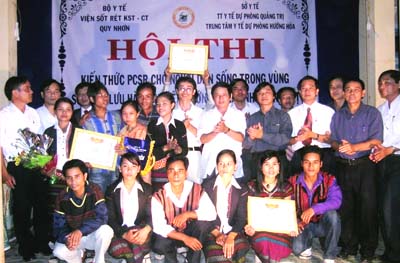 |
The competition on malaria control knowledge for ethnic minorities
in Huong Hoa district, Quang Tri province. |
Trainings and intensive trainings
The Institute continues conducting 3 classes for secondary laboratory technicians, prepares the final exam for the Course 30, coordinates with Medicine and Pharmacy Department of Tay Nguyen University in teaching the speciality of parasitology and instructing post-graduates in the field of parasitology.
The regional provinces had conducted 524 training classes for 11,638 participants who are health workers at communal level and in hospital and technicians at various levels in order to enhance the effectiveness of local malaria control activities.
Scientific research
In collaboration with the provinces, the Institute had conducted the scientific research projects of Ministerial level, Institute level and international cooperation projects in the fields of malaria epidemiology, malaria entomology, malaria parasitology on drug-resistance, intestinal parasitology, malaria clinic and treatment.
The Institute also enhances the capicity of basic scientific research on biological and genetic engineering, molecular biology, immunitology, consecutive parasite culture, ultrasound scan, and cardio-endoscopy.
Orientation of malaria control in the second half of 2009
Objectives of malaria control in 2009
General objective
Continue to roll back malaria in severely-hit areas, areas with high risk of malaria outbreaks and develop sustainable factors so as to prevent malaria return.
Specific objectives
- Reduce morbidity rate by 5% against 2008 and by 1.17 0/00 of the total population in 2009.
- Reduce mortality rate by 5% against 2008 and by 0,08 0/0000 of the total population in 2009.
- Prevent malaria outbreaks from occuring, or stop immediately if they happen.
- Continue developing stable elements and socialize malaria control programme so as to prevent malaria return, maintain malaria control achievements.
The norms for 2009
- Population protected by insecticides: 3,744,000
In which:
+ Protected by residual-chemicals: 617,000
+ Protected by impregnated bed-nets: 3,127,000
- Malaria treatment turn: 286,000
- Detected blood slides : 805,000
Malaria control activities in the last half of 2009
It is predicted that the malaria situation will tend to increase by the end of 2009. In order to prevent the possible outbreaks of malaria, the first and forehead objective is to restrict the spread of disease, prevent the development of malaria epidemics and deaths from occuring. Malaria control measures in the last half of 2009 are given the guidelines as follows:
Malaria epidemiological surveillance and control measures
Make a plan for malaria control measures suitably at grass-root levels, strengthen epidemiological surveillance in severely-hit areas, areas of mobilised population to prompt detect and prevent the increase of malaria.
Provide anti-malaria drugs for self-treatment, especially mobilised people, people going into the forests, sleeping at field huts.
Prepare adequate amounts of anti-malaria drugs, insecticides, materials and fund to supply for provinces if occuring the epidemic.
Guide provinces/districts to enhance the quality of statictis, report, analysis figures and prediction of malaria epidemic by new forms and Malaria Management System (MMS).
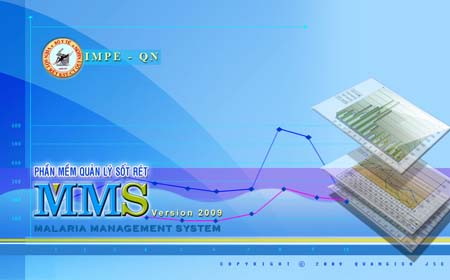 |
Malaria Management System (MMS)-Version 2009 |
Vector surveillance and vector control
Deploy indoor residual spraying and bednet impregnation on the basis of interventional malaria epidemiological stratification of malaria epidemiology; especially spray in severely-hit areas.
Enhance the quality of spraying and bednet impregnation; the Institue and provinces need to strengthen surveillance of spraying and bednet impregnation.
Propagate people to sleep in bednets, take bednets when going to the forests.
Strengthen vector surveillance and vector control measures in severely-hit areas, areas of mobilised population.
Diagnosis, treatment and management to malaria patients
The grass-roots health care network (district, commune, village) have to detect and treat timely for mobilised population, people going to malaria-endemic areas and getting malaria.
Enhance the quality and the effect of microscope to prompt detect and treat for malaria patients at grass-root levels.
Supply highly effective anti-malaria drugs under the given plan; provide free anti-malaria drugs to hamlets, villages and monitor closely malaria patients.
Health communication and education for malaria control
Strengthen health communication and education for malaria control suitably to every region.
Develope and enhance the quality of communication network, supply documents, poster, cassette, video on malaria control; hold the competition on malaria control knowledge for ethnic minorities in remote areas.
Scientific research, information technology and international cooperation
Deploy ministerial-level projects, international cooperation projects and Institute-level projects to solve the problems on malaria control; collborate with World Health Organization (WHO), the Australian Army Malaria Institute...
Apply the effect of the IMPE's website to develope information network such as LAN network, Tele-conference, Email and management software.
The management of anti-malaria drugs, insecticide, materials and fund for malaria control
Monitoring the management, utilisation and report of anti-malaria drugs, insecticide, materials and fund under the Malaria Control Project's regulation; not using expired or inventory stocks; manage and use materials, fund granted by the Global Fund Project effectively.
Guiding the provinces to make plans on malaria control for 2010.