From 2009 to now, especially in first 6 months of 2010, malaria situation increased continuously with high risk of outbreaks. However, the Institute of Malariology, Parasitology and Entomology Quy Nhon (IMPE Quy Nhon) has coordinated with the provincial health services to enhance the quality of malaria control, thereby decreasing malaria indexes and stabilizing malaria situation.
Malaria situation in first 6 months of 2010 against the same period of 2009
Malaria morbidity
Malaria morbidity in the whole region, as compared with the same perid of 2009, increased by 13.16%, with the Central Coastal area 18.76% higher, the West Highlands 5.43% up.
9/15 provinces with increased rates of malaria morbidity included Quang Nam (168.56%), Phu Yen (60.25%), Binh Dinh (54.21%), Dak Lak (36.93%), Quang Ngai (30.36%), Da Nang (20%), Khanh Hoa (16.03%), Kon Tum (2.72%) and Quang Binh (0.17%).
6/15 provinces with decreased rates of malaria morbidity included Quang Tri (-46.50%), Thua Thien-Hue (-37.76%), Ninh Thuan (-23.08%), Binh Thuan (-20.06), Dak Nong (-8.29%) and Gia Lai (-6.57%).
Malaria parasites
The malaria parasite rates in the whole region, as compared with the same period of 2009, increased by 56.42%, with the Central Coastal area 65.17% higher, the West Highland 48.29% up.
12/15 provinces with incresed rates of malaria parasites included Quang Nam (284.51%), Quang Ngai (204.22%), Kon Tum (154.80%), Dak Lak (143.14%), Phu Yen (109.46%), Binh Dinh (101.02%), Binh Thuan (68.80%), Da Nang (35.63%), Khanh Hoa (30.78%), Thua Thien-Hue (20.51%), Quang Binh (16.38%) and Dak Nong (13%).
3/15 provinces with decreased rates Quang Tri (-47.52%), Ninh Thuan (-29.90%) and Gia Lai (-5%).
Severe and complicated malaria
In the first 6 months of 2010, the whole region had 30 severe malaria cases, decreasing by 18.92% compared with the same period of 2009, with the Central Coastal area 10 cases lower and the West Highland 4 cases higher.
Malaria death
In the first 6 months of 2010, the whole region had 2 deaths from malaria in Khanh Hoa and Binh Thuan.
Malaria epidemic
There was no outbreak occuring.
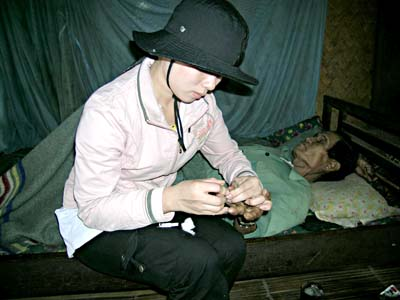 |
Taking blood smears for the detection of malaria parasites. |
The cause of increasing malaria morbidity and mortality
Subjective cause
The people have no awareness of self-protection as living in malaria-endemic areas; especially the low rate of bednets usage creating favourable conditions for the spread of the epidemic. The provision of stand-by treatment is not really effective while the main vectors (An.minimus, An dirus) tend to recover and the malaria parasites rates still make up high rates in the community. Health facilities at grass-root levels (communes, hamlets) were unable to detect early and treat promptly malaria cases as well as give emergency measures for severe malaria cases; moreover, patients often do not go to health centers for medical examination and treatment.
Objective cause
Remote and border areas of Central Vietnam are highly-endemic malaria ones with complex malaria epidemiological characteristics which are favourable for the natural transmission of malaria. Malaria control measures for mobilised population (people going to work in the forests, sleeping in the field huts and crossing the borders) were out of control of health service. Besides, the varying weather created favourable environtment for the development of vectors; and especially the cycle of malaria outbreak often return from 3 to 5 years after the decreasing period of malaria situation.
Evaluation of malaria control activities in the first 6 months of 2010
Steering guidance
From the begining of 2010, the IMPE-Quy Nhon sent many urgent documents to health department, malaria control/health preventive centers to strengthen malaria control measures at localities; and the Institutes directly steered malaria control activities in severely-hit areas.
The provinces strengthened the quality of malaria control measures, provided supplementary integrated measures at high-risk areas such as mobilised population, border, remote areas.
Malaria control networks also attached importance to enhance the quality of technical measures in malaria control campaigns and actively control in malaria-endemic areas (areas having mobilised people, people going to work in the forests and sleeping in the field huts and those crossing the borders); health care network at grass-root levels (districts, communes, villages, microscopic points) participated actively in malaria control activities. However, the detection and treatment early, malaria patient management at grass-root levels still had a lot of difficulties, especially at the Laotian-Vietnamese border area due to no border cooperation in malaria control.
Malaria epidemiological surveillance and epidemic control
The Institute coordinated with the provinces to arrange the epidemiological surveillance missions at severely-hit and highly-endemic malaria areas so as to evaluate malaria situation, propose solutions and control the risk of increasing malaria.
The Institute also improved the quality of malaria control measures and gavesupplementary measures such as residual spraying, bednet impregnation and treatment for high-risk areas; epidemiological surveillance activities at severely-hit areas and briefing conferences between communes, districts and provinces were continuously maintainted, thus the information was analysed, control timely malaria outbreaks.
Vector control
The Institute provided chemicals for residual spraying and bednet impregnation, ensuring that all provinces deployed the given plan to protect 686,481 people, with 549,761 people by bednet impregnation, 136,720 people by residual spraying before the developing season of the epidemic in the first 6 months of 2010.
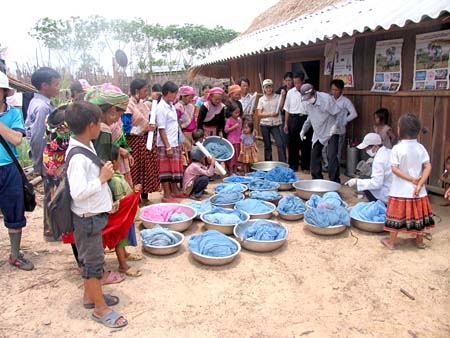 |
Treating bed-neds for malaria prevention. |
Diagnosis, treatment and antimalarial drug management
The Institute allocated enough anti-malaria drugs for health centres; besides, strengthening the diagnosis and treatment of malaria at grass-root levels.
The provinces enhanced the quality ofmalaria parasites detection at microscopic points to treat patients promptly; in the first 6 months of 2010, all provinces of the region sent the blood slides for examination with the general error rate of 0.16%, including the Central Coastal area 0.15%, and the West Highland 0.20% aganist the same period of last year.
Health Communication, Education and Socialization of Malaria Control
The provinces held the propaganda talks, radio broadcast, group discussions with 37,843 turns for 4,637,629 people-times; direct communication at households with 7,354 turns for 12,380 people-times; video shows and cultural shows; malaria control campaigns on World Malaria Day 25 April at severely-hit areas enhanced the awareness of the people in malaria control effectively.
The Institute organized the "Competition on malaria control knowledge for ethnic minorities" at An Lao district (Binh Dinh) and Tuyen Hoa district (Quang Binh); held the launching ceremony on propagating World Malaria Day 25 April at Phong Dien district (Thua Thien-Hue).
Trainings and intensive trainings
The Institute conducted 10 training classes "Guidance on diagnosis and treatment of malaria" for 268 medical staff of provincial and district levels; evaluation of increasing malariamorbidity and mortality; the quality of malaria diagnosis and treatment at grass-root levels; new points in the training course "Guidance on diagnosis and treatment of malaria"; clinical diagnosis and treatment of uncomplicated malaria, symptom of pathogenesis, specific treatment.
The provinces conducted 59 training courses for 1,852 medical staff of districts, communes and technicians at grass-root levels; held the training classes on diagnosis and treatment for the districts and communes of Vietnam Global Fund Malaria Control Project.
Scientific research
The Institute collaborated with the provinces in conducting the scientific research projects of Ministerial level, Institute level and international cooperation projects of malaria epidemiology, malaria entomology, drug-resistant malaria parasitology, intestinal parasitology, clinic and malaria treatment.
The Institute also maintained the scientific workshop quarterly, updated the information frequently on epidemic situation of the country and the world.