With a view to enhancing the effectiveness of the prevention and control of medical insects in general and malaria vectors in particular in Central Vietnam, updating the information and improving technical skills for entomologic staff, the IMPE-Quy Nhon hold the training course on malaria vector control skills in 2013 for entomologic staff of the provincial malaria control centres/provincial centres for preventive medicine in 15 provinces of Central Vietnam.
In the malaria control programme, the expense of malaria vector control activities has made up more than half of the total budget, so it is necessary to enhance the effectiveness of vector control measures. For this, these measures must be carried out timely and appropriately to every period and every area; and we can only achieve these desired results when we have sufficient information on need-to-be-controlled objects, including malaria vectors, vectors-related information and vectors control measures. Besides, blood-sucking bugs have appeared in many areas of 20 provinces in recent years, thus the detection, surveillance and control measures of vectors are very necessary in this period.
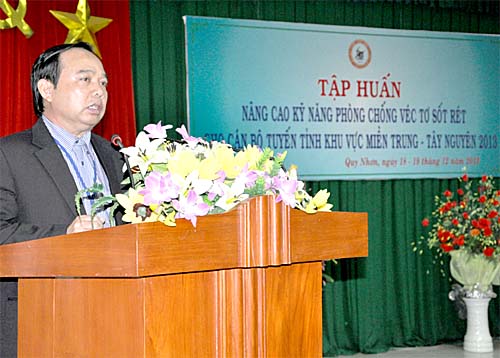 |
Dr. Nguyen Van Chuong, Director in his directive speech at the training course |
Medical staff studying malaria vectors in particular and medical entomology in general are assigned their tasks at the institutes of malariology, parasitology and entomology and other provincial malaria control centres/provincial centres for preventive medicine. Especially, they provide counselling for the leaderships of the institutes, the management board of the National Malaria Control Project and the management board of the National Dengue Fever Project (two projects are parts of the National Target Program on prevention and control of a number of social diseases, dangerous epidemics and HIV/AIDS in the 2006-2010 period) on vector surveillance and effects of vectors control measures, thereby drawing up the strategy of using insecticides and the most suitable measures for malaria and dengue fever control.
In the past years,malaria vector control activities in Central Vietnam contributed to malaria prevention, reduction of malaria morbidity, mortality and epidemic. Techniques of insect study were included collection of samples, identification of species, physiological and ecological characteristics, evaluation on role of transmitting diseases, susceptibility to insecticides of malaria vectors, evaluation on the effectiveness of control measures. Beside the knowledge of chemical, the regulation of management, use of chemicals were necessary for entomology staff. Therefore, update the information frequently, enhance the quality of techniques for entomology staff were very necessarry; and these were the aims of the training course "Enhance vector control skills for medical staff at provinces of Central Vietnam in 2013".
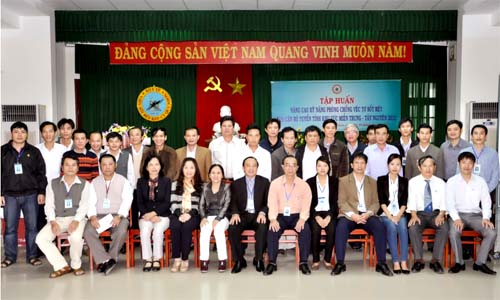 |
Representatives, teachers and trainees at the training course |
Participants to the training course included the leaderships of IMPE-Quy Nhon such as Dr. Nguyen Van Chuong, Director; MSc. Huynh Hong Quang, vice-director; heads of departments and staff of Entomology Department; besides, there were the attendence of entomological staff of provinces of Central Vietnam.
The content of the training course included malaria situation and vector control activities in Central Vietnam 2010-2013; malaria vectors and control activities in Vietnam; the distribution of malaria vectors and vector resistance to insecticides in Vietnam 2004-2013; the process of susceptibility testof Anopheles to new insecticides according to WHO technique 2013; the theory of biological testing technique to identify the efficacy of insecticide on walls; the theory of biological testing technique to identify the efficacy of insecticide on bednets; Chagas and its control measures in the world; blood-sucking bugs and control activities in the world and in Vietnam.
In practice, including susceptible testing technique of insecticides to Anopheles mosquitoes according to WHO technique 2013; practising technique of biological test to identify the efficacy of insecticides on walls; practising technique of biological test to identify the efficacy of insecticides on bednets; practising on identifying species of blood-sucking bugs in Vietnam. The training course also discussed malaria vector surveillance activities and control measures at provinces; malaria vector situation and vector control activities; vector control surveillance at localities; difficulties and shortcomings of provinces in control and surveillance activities and suggestions for vector control in the next time.
The result of the training course showed vector control situation at present as follows: the indexes of vector points were very high; the appearances of two main vectors An.dirus and An.minimus were most of provinces of Central Vietnam; main vectors was detected in field huts. Many provinces had environmental changes drastically, affecting mosquito population such as irrigation system, hydroelectric system, rubber tree plantation and other forests, etc…; especially, in this year, the weather was very changeable, which created favourable conditions for the development of vectors, so vector control measures needed to be strengthened.
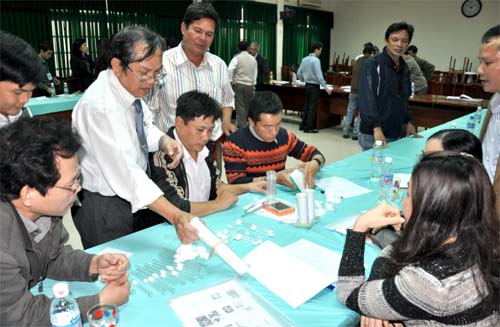 |
Trainees practising susceptibility testing technique |
Vector surveillance and control measures at localities as follows: total of entomology staff in every province was an average of 4 - 5 people a province, or some provinces only had 2 entomology staff; moreover, some of provincial centres combined epidemiological surveillance, test and entomology each other. These are difficulties for entomology staff at localities in the implement of vector control. Besides, in many provinces, specialized equipments, materials such as light trap, baited mosquito trap, etc. were broken and had not been allocated. Therefore, surveillance and control activities were limited, and health services of districts have not carried out any surveillance measures.
Through the training course, entomology staff suggested the leaderships of National Malaria Control Project, the leaderships of the IMPE-Quy Nhon to make plan for buying and supplement necessary materials in vector surveillance in the provinces. The suggestions included training courses on technique and research methods in the next time to enhance the quality of entomology staff; unify report forms and report regulation on vector surveillance and control activities for the provincial centres to report the IMPE-Quy Nhon.
The IMPE-Quy Nhon has made plan for surveillance and support of provincial centres to improve techniques of susceptibility test to insecticides and propose the issue of national certificate on testing techniques for the centres. Moreover, the Institute also gave the suggestion for the leaderships of the provincial malaria control centres/provincial centres for preventive medicine to create conditions for deploying vector surveillance activities and control measures.
Besides, the training course was an opportunity for entomology staff to exchange and study experiences each other.