In the past few years, the IMPE Quy Nhon has achieved a great deal of success in biological technology applied research in medicine, especially in the field of molecular biology; and in the coming years the Institute will continue intensifying these activities with an aim of diversifying the people's healthcare duties.
With this target, the IMPE Quy Nhon has provided some information on research activities applying biological technology which have been carrying out at the Institute and the orientation for development from now to 2020 as a basis for the cooperation with concerned units on a national scale in general and in Binh Dinh province in particular with the purpose of advocating the development of the biological technology application in medicine and healthcare in order to effectively control dangerous diseases and satisfy the diversified need of people's healthcare.
Application of biological technology at the Institute
In specialized research
Entomology
Apply Polymerase Chain Reaction (PCR) in identifying and differentiating malaria vectors from other disease non-transmiting Anopheline mosquitoes; in defining and classifying vector transmiting the diseases of dengue fever, lymphatic filariasis, tsutsugamushi and so on; specifying the distribution areas of malaria vectors molecularly.
Malaria parasitology
Define and classify different parasites causing malaria in humans, distinguish different types of malaria parasites in humans, differentiate the relapse and reinfection of malaria parasite after treatment.
Define the types of drug-resistant parasites, malaria parasite structures, rates and distribution of drug-resistant parasites in the region.
Helminthology
Identify trematodes causing Fascioliasis in humans and define the distribution of Opisthorchis viverrimi and Fasciola gigantica in Central Vietnam by molecular biology techniques.
Training and scientific research
Provide training and instruction in terms of molecular biology techniques for provincial level units which are capable of handling molecular biology. Strengthen cooperations with other institutes and universities in the country and all over the world in terms of scientific research and update new molecular biology techniques.
Medical examination and treatment
Cooperate with the Institute's Clinic of malaria and other parasitic diseases in the application of molecular biology techniques to diagnose the agents causing human diseases, for example Hepatitis B or C by the Real-time PCR technique.
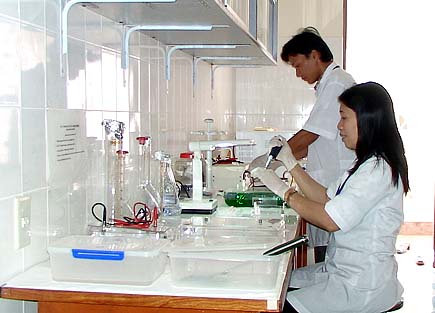 |
Institute's staff at the lab of Department of Molecular Biology |
Prospects of the molecular biology application by 2020
Investment of material and equipment facilities
The Institute is planning to build a central laboratory with modern equipment in order to serve specialized researches as well as the diagnosis and treatment, ensuring the testing quality in accordance with the ISO standard.
Application in specialized researches
Entomology
Continue PCR application in defining and classifying the primary malaria vectors and secondary vectors; in defining and classifying vectors transmiting the diseases of Dengue fever, Lymphatic filariasis, Tsutsugamushi and so on; specifying the distributing areas of malaria vectors molecularly.
Define the chemical-resistant mechanism of malaria vectors at molecular level, preserve the genes of malaria vectors (An. minimus, An harisoni, An. dirus) in Central Vietnam.
Malaria parasitology
Continue defining and classifying different parasites causing malaria in humans, distinguishing different types of malaria parasites in humans, diagnosing to distinguish between the relapse and reinfection of malaria parasite after treatment; defining the types of drug-resistant parasites, the structure of malaria parasite and the rates and distribution of drug-resistant parasites in the region.
Define the chemical-resistant mechanism of malaria parasite at molecular level, preserve the gene of malaria parasites (P.falciparum, P. vivax, P. malariae, P. ovale) in Central Vietnam.
Helminthology
Continue applying molecular biological techniques to define the species of Opisthorchis viverrimi and Fasciola gigantica, the molecular distribution of parasitic worms in humans and other parasitic worms which have important medical roles in Central Vietnam.
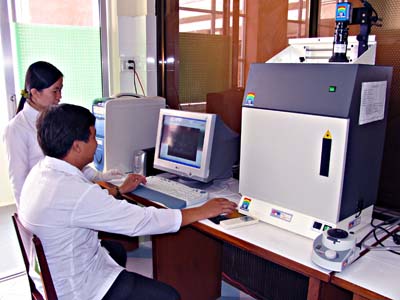 |
Results of electrophoresis displayed on UV. |
Training and scientific research
Continue developing the training and instruction of molecular biology techniques for provincial level units which are capable to be engaged in molecular biology; extend cooperation with the institutes and universities of the country and the world in scientific research and update new molecular biology techniques.
Medical examination and treatment
Strengthen the coordination with the Institute's clinic, health care facilities in the province as well as the whole country in the application of molecular biology to diagnose agents causing human diseases.