On 9-15 October 2010, in Wuxi, Jiangsu, China, the workshop on Malaria Elimination Strategy and New Technology in Mekong Region was held with the aim of strengthening the cooperation in malaria control among Mekong countries, sharing the experience and technology from control to elimination, promoting the progress of regional malaria elimination.
Participants to the workshop includedleaderships of Chinese Ministry of Health, Jiangsu Health Service, Yunan Institute of Parasitic Diseases, representatives of the Research Institutes in Mekong Region such as Cambodia, China, Lao PDR, Thailand and Vietnam. The Vietnamese mission consisted of 3 representatives Nguyen Quy Anh, MSc from the National Institute of Malariology, Entomology and Parasitology (NIMPE), Phung Duc Thuan, MSc from IMPE Ho Chi Minh and Ho Dac Thoan, BSc from IMPE Quy Nhon.
The content of the workshop had 4 main parts, including the strategies and technology for malaria elimination program in China; visiting and working at some communes and districts conducting the elimination programme (Yuxi district); visiting some of institutes, research centres of parasitic diseases (Shanghai); countries' reports on achievements and experiences in malaria control activities.
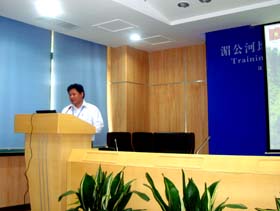 |
Ho Dac Thoan, MSc from IMPE Quy Nhon in his speech
on the achievements, experiences and challenges
in Vietnam's malaria control programme. |
The workshop listened the presentation of the leading specialists about the objectives of malaria elimination programme, the difficulties and challenges in implementating this programme. Besides, the experts from the universities, the nongovernmental organizations and the medicine groups researching on antimalarial drug also reported on operational research, strategies and new technology for malaria elimination programme such as Geographical Information System, Polymerase Chain Reaction, etc.
According to the report, the malaria elimination programme of China was approved in July 2010. With the aim of the programme, by 2015, there will be no malaria morbidity except Yunnan province (bordering Vietnam, Laos and Myanmar) and by the end of 2020, there will be no morbidity case in China.
The funding of Malaria Elimination Programme stage 1 (1 July 2010 - 30 June 2014) in China was of two sources: from Chinese government USD 158,100,000 and from Global Fund Malaria Control Project about USD 10,050,806.
At the end of the workshop, the representatives presented and shared the achievements,experiences and challenges on malaria control and elimination activities in their countries such as the recently emerged artemisinin resistant Plasmodium falciparum in the Cambodia and Thailand border, and the increasing of international movement at border areas; at the same time, they also proposed activities and operational research for cooperation programmes in Mekong region.
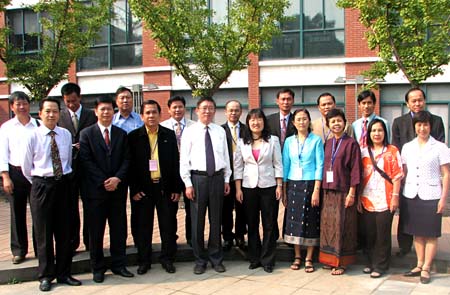 |
Participants to the Workshop |
In 7 days of working, the workshop finished successfully. Prof. Gao Qi, the expert of the project, vice-director of the malaria control project, director of the China Institute of Parasitic Diseases appreciated the exchange of information on malaria situation as well as the cooperation and critical suggestion of the countries. on behalf of Chinese Malaria Control Programme, Prof. Gao Gi hoped that such workshops will be held annually and the information exchange system on malaria situation at border areas and of mobilised polulations in Mekong region will be established in the future.