On 4-15 October 2010, the first Integrated Vector Management (IVM) Training of Trainers' Workshop was held in Manila Philippines at Traders Hotel, Manila by the Department of Health of Phillippines in collaboration and support from USAID-Asia and WHO, through the Asian Collaborative Training Network for Malaria (ACTMalaria).
Integrated Vector Management (IVM) is defined as "a rational decision-making process for the optimal use of resources for vector control". The basic principles of IVM are outlined in the Global Strategic Framework on IVM (WHO-2004). In 2008, WHO issued a position statement on IVM to support the advancement of the concept as a component in vector-borne disease control. The global strategic plan on IVM has emphasized the urgent need for capacity building, while the global action plan on IVM proposed the development of a comprehensive modular training package on IVM, from which this training has been adopted.
Participants to the course included 17 staff in medical entomology from (2), Indonesia (2), Malaysia (2), Philippines (6), Thailand (2) and Vietnam (3). The Vietnamese representatives were Dr. Pham Thi Khoa, from the National Institute of Malariology, Parasitology and Entomology, Nguyen Xuan Quang, MSc, from the Institute of Malariology, Parasitology and Entomology (IMPE Quy Nhon), and Le Tan Kiet, BSc, from IMPE Ho Chi Minh.
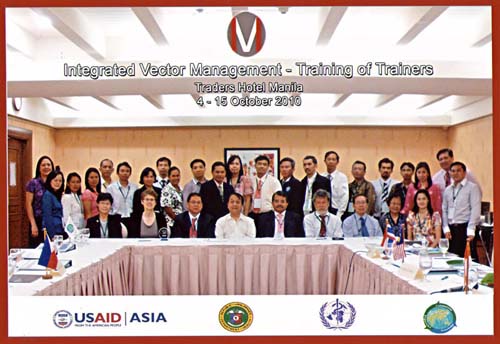 |
Participants to the Workshop. |
The objectives of the course are to develop IVM teams in ACTMalaria member countries that support capacity building and application of IVM approach using all available tools with multi-sectoral coordination and partnership to reduce dependence on a single vector-borne diseases control strategy.
With these purposes, the participants would be equipped with necessary knowledge and skills to support capacity building and application of IVM approach in controlling vector-borne diseases. The course applied the active training approaches, introduced basic theory as well as attached special importance to the practice so as to help the participants be able to apply IVM in their countries in the future. The participants were divided into three work groups to discuss group exercises as well as to contribute their ideas, compare and analyse problems involving vector-borne diseases with the instruction and assistance of trainers and assisstant trainers.
| Work groups discussing, exchanging and analysing the problems involving vector-borne diseases. |
In addition, the participants also went for field trip practice to survey, analyse and work with the community of Cawag commune (
Subic), a region with coexistence of malaria and dengue. This was the practical content of problem analysis on malaria and dengue, thence putting forward the methods of IVM application in vector-borne disease prevention in this area.
Beside that, every country's representative were assigned the task of setting up a proposal for the plan of IVM application and implemetation in the national integrated vector control so as to present and defend it at the end of the course. The Vietnamese participants has designed the proposal of the pilot action project for the development and implementation of IVM in malaria and dengue control in Van Canh district, Binh Dinh province.
Nguyen Xuan Quang, MSc, staff of IMPE Quy Nhon presenting the proposal of Vietnamese participants . |
The project of Vietnam's participants was designed with the purpose of developing IVM strategy in malaria and dengue prevention in Van Canh district (Binh Dinh province), a typical district of the central coastal area with the prevalence of both malaria and dengue, to reduce damages caused by vector-borne epidemics in Binh Dinh province in particular and Vietnam in general. This project was expected to receive supports of expenditure, materials and and techniques from ACTMalaria Foundation, WHO Vietnam Office and Vietnam Malaria Global Fund.
| MoH's leadership of Phillippines awarding the certificate to participants |
If the project is supported and achieved expected results, the model and results of the project will be proposed to the directorial board of the national malaria and dengue control programmes so as to widely apply and implement in other areas of Vietnam.