For years and years, the World Health Organization (WHO) has been supporting the disease prevention and people's health improvement in poor countries worldwide in all aspects. As a health organization having the world's leading technical experience, in recent years, WHO has helped Vietnam to implement many projects which not only contribute to reduce disease burden and improve the people's health in the worst disease-affected areas, but also help enhance the capacity of health staff in difficult, mountainous and outreached areas in Vietnamese territory.
Participants to the workshop include Dr. Nguyen Thi Xuyen, Vice Minister of the Ministry of Health (MoH), Assoc.Prof. Pham Le Tuan, Director of the Department of Planning and Finance (DoPF), Dr. Nguyen Hoang Long, Deputy Director of DoPF and MoH's specialists and Dr.Jean-Marc Olive, WHO Representative in Vietnam. In addition, there are more than 80 representatives from agencies directly under the MoH (departments/ administrations/ institutes/ central hospitals) who are project implementing partners in fiscal year 2010-2011.
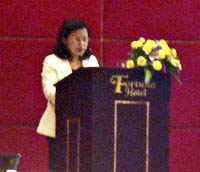 |
Dr.Nguyen Thi Xuyen, Vice Minister of MoH
in her directive speech at the Workshop |
With the ODA fund of over USD 34.9 million (including counterpartfunds of 200,000 USD), the project includes most of the activities of 15 major components in the Vietnam's public health operation such as health system policies and coordination; health planning; monitoring and evaluation; and health information system development programme; human resources for health; health care financing; social determinants of health-gender-human rights; health technology, laboratories, blood safety, pharmaceuticals; prevention and control of non communicable diseases, mental disorders, violence, injuries and visual impairment programme; health promotion-tobacco free initiatives; environmental health and occupational health, prevention and control of HIV, Tuberculosis and Malaria, maternal and child health programme; prevention and control of communicable diseases in Vietnam; immunization and vaccine development.
Unlike the previous fiscal years, the collaboration project with WHO in the 2010-2011 Biennium involves more than 80 Vietnamese partners - the as yet largest number of partners. Accordingly, a project management unit was established to directly manage activities of the project-participating units, such as directing, coordinating, integrating activities, ensuring the effectiveness of projects, recapitulating componential reports into the general report of the project and implementing the project in accordance with current regulations, etc.
As one of the main objectives of the project fiscal year 2010-2011, the control activities of HIV, Tuberculosis and Malaria are of special interest and thus the investment fund for these activities amounts to over $5.6 million. Some technical works serving the drug-resistant malaria parasites studies, measures against malaria recrudescence, training in effective treatment methods of antimalarial drugs and establishment of new guidelines for malaria treatment are constantly-concerned activities with the participation of the Institute of Malariology, Parasitology and Entomology Quy Nhon in collaboration with the National Institute of Malariology, Parasitology and Entomology, the Institute of Malariology, Parasitology and Entomology Ho Chi Minh and WHO staff.
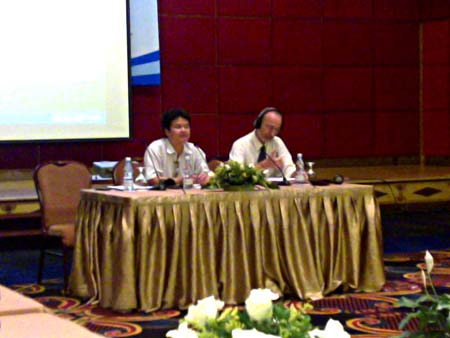 |
Assoc.Prof. Pham Le Tuan, Director of the Department of Planning and Finance (DoPF)
and Dr.George Slama presiding the plenary discussion session of the workshop. |
Addressing at the workshop, Dr. Nguyen Thi Xuyen, Vice Minister of MoH, on behalf of the leaderships of Vietnam Ministry of Health, was thankful for WHO's kind help to the health sector in Vietnam. "The Ministry of Health is very happy and excited as continuing to be supported by WHO in the cooperation project of the next financial year (2010-2011). The WHO cooperated health project is one of the few projects implemented in many departments, administraions and units directly under the MoH. This is an advantage as well as a big challenge in the project management and coordination...". The deputy minister expressed the desire that the Project Management Unit (PMU) and implementing units continue to closely coordinate with the WHO in Vietnam to carry out the activities effectively in accordance with the objectives of the project because it is a relatively major project with the participation of many departments and agencies directly under the MoH.
Dr.Jean-Marc Olive - WHO Representative in Vietnam said that in the context of lots of challenges to the health care approach to Vietnamese people, the Health Cooperation Project with WHO, financial year 2010-2011 was an opportunity for us to exchange valuable experiences through technical activities within the framework of the project components so as to meet the people's ever-increasing demand of healthcare. With the budget mobilized up to USD 34.9 million for fiscal year 2010-2011, WHO has been trying very hard to find the different sponsor sources in the world. So far, due to many different causes, the project can only be implemented in mid 2010, therefore the project implementing units should get to carry out activities in the project components immediately to keep up with the disbursement.
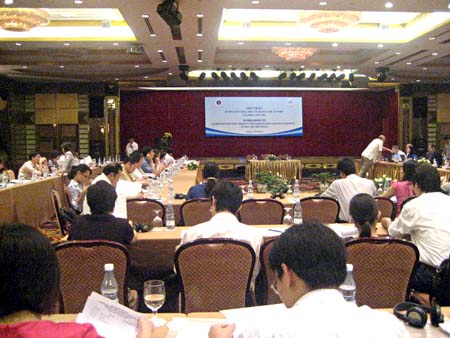 |
| Workshop on Guidlines for WHO Project Implementation and Management in 2010-2011 Biennium |
The workshop listened the presentation of the DoPF's leadership of the contents and plans of the project. The DoPF has also given the detailed instruction of activities of the Health Cooperation Project with WHO in the 2010-2011 Biennium, such as the processes of implementing the Direct Financial Cooperation (DFC), Agreement for Performance of Work (APW), Fellowship, and plans, strategies of the Detailed Project Outline (DPO). The WHO representatives in Vietnam instructed the WHO plans, strategies and regulations in implementing the project. The officials and experts of WHO and DoPF presented the guidelines for project implementation.
The WHO Cooperated Health Project, fiscal year 2010-2011 has been developed in the context in which UN agencies and the Vietnamese Government are working together to initiate the "One UN" so as to change the ways of cooperation in order to best contributive to the developing process thereby improving the aid effectiveness. WHO will joint the "One UN" initiative in the phase 2, therefore the project management mechanism will be the same as the one regulated by the UN.