In the first months of 2010, Fascioliasis situation in Vietnam has seemingly cooled down because the source of specific drug (Triclabendazole) has been provided sufficiently for health services. However, this situation is not stable and high risk of outbreak can occur at any time, especially in the provinces with high rate of morbidity of Central Vietnam. To carry out Fascioliasis control measures, the Institute of Malariology, Parasitology and Entomology Quy Nhon (IMPE-Quy Nhon) has coordinated with the Institute of Biotechnology (IB) and the Prince Leopold Institute of Tropical Medicine, Belgium (ITM) to set up the international cooperation project on researching and controlling this disease in Central Vietnam.
The international cooperation project on epidemiological research, infected environment and control of Fascioliasis in human and animals in Central Vietnam between IMPE-Quy Nhon and the Prince Leopold Institute of Tropical Medicine, Belgium was approved to sponsore by the Belgian government.
From 9 to 10 of August 2010, at the IMPE-Quy Nhon, the Belgian experts included Dr. Pierre Dorny, Head of Department of Animal Health, Dr. Sarah Gabriel, research assistant of ITM and partners in Vietnam included Dr. Le Thanh Hoa, Head of Immune Department (IB), Dr. Trieu Nguyen Trung, Director of IMPE-Quy Nhon together with some of the leaderships of IMPE-Quy Nhon. In the two days, the partners discussed the actual situation of Fascioliasis in Vietnam to complete additional research targets, the contents of activities, research equipments and implementing budget; besides, the expert mission visited the laboratories and the Insitute's clinic, chose one district of Binh Dinh province to survey and assemble Fascioliasis specimens from grass-grazing animals.
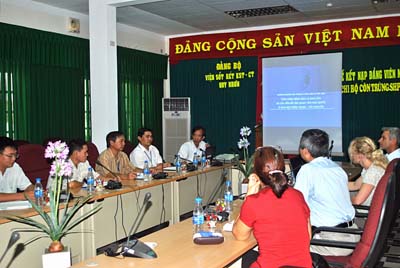 |
The Belgian expert mission visiting and working with the leaderships of IMPE-Quy Nhon |
The result of studying indicated that morbidity rate of Fascioliasis in human is common. From the beginning of this year, Fascioliasis situation hasn’t considerably changed yet. But, in the first 7 months of 2010, according to the statistics, there were about 2,000 morbidity cases and 2,500 cases of follow-up examination, mostly in the provinces of Binh Dinh, Quang Ngai, Quang Nam, so compared with previous years, Fascioliasis morbidity rate of Central Vietnam made up 92% against the whole country. In comparision with Fascioliasis situation from 2006 to now, morbidity cases have increased and decreased irregularly; for example, in 2006, morbidity cases increased 3,838, then decreased 2,196 in 2007 and 2,000 in 2008 due to being provided with Triclabendazole. However, up to 2009, this drug source was not sufficient for distribution, so morbidity cases drastically increased 4,300. In first half of 2010, Fascioliasis situation tended to decrease because health services took the initiative in providing anthelmintic drugs (Triclabendazole) for patients. Therefore, if the provision of anthelmintic drug is not maintained regularly, the number of morbidity cases will continue to increase as the previous years.
Because the anthelmintic drugs are provided widely, Fascioliasis situation is not "a burning problem" like before. However, in the first 7 months of 2010, morbidity cases was of nearly 2,000, mainly in the provinces of Binh Dinh, Quang Ngai, Quang Nam, Da Nang, Phu Yen, Khanh Hoa and Gia Lai. Therefore, the project takes the special interest in the reason why the diseases just appeared in these 7 provinces; especially in Binh Dinh and Quang Ngai provinces.
The Belgian expert mission visiting the Institute's laboratories. |
During the two-day visiting, the international cooperation project on Fascioliasis was completed the sufficiently supplementary information for the partners before being approved in Belgium. According to the plan, the project will be carried out in the period of 4 years (2011-2015) with the attendance of the international and Vietnamese experts in the field of Fascioliasis. If the project is implemented, not only the people of Central Vietnam have benefit from control measures but the medical staff participating in the project can also improve their technical qualification (M.Sc, PhD) in Belgium.