From March 28 to April, 2010 the Asian Collablrative Training Network for Malaria (ACT Malaria) conducted the fifth Inter-Country Transfer of Training Technology (TTT) with the financial supports from USAID/WHO and Ministry of Health (Malaysia).
Participated in the training course included 19 participants from ten member countries, including: Thailand (2), Cambodia (2), Laos (2), Bangladesh (1), Malaysia (2), Indonesia (2), Philippines (2) and Vietnam (4). Two participants came from Solomon Islands as a non-member country. Four Vietnamese partcipants attended the course, including:
Mr.Tran Minh Quy, MPH-from Institute of Malariology-Parasitology and Entomology, Quy Nhon;
Ms.Thai Cong Tuan Anh, B.Sc-Institute of Malariology-Parasitology and Entomology, Hochiminh City;
Ms.Nguyen Thi Thu Trang, M.Sc.-from National Institute of Malariology-Parasitology and Entomology; and
Mr.Doan Quang Ha, MD.- from National Institute of Malariology-Parasitology and Entomology
The purpose of the 2010 TTT course is to develop training teams who will be able to improve the planning, implementation, development and follow-up of national courses and international ACT Malaria courses that address defined needs for improving malaria control. At the end ot the course, the participants will be able to:
- Assess the training needs (identification of problems as lack of knowledge and skills; and then define the rationale for training);
- Design training curriculum based on participatory learning approaches;
- Coordinate and implement the training;
- Evaluate the training.
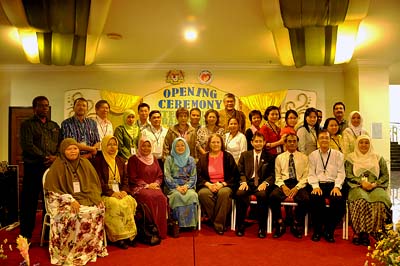 |
Participants to the training course. |
The 2010 TTT applied the learner centered and participatory learning methods. Problem-based learning is introduced to foster and cultivate life-long learning skills and process. The case studies based on actual events and existing data were designed to challenge participants' knowledge and skills in solving the problems. The participants were divided into 4-5 small groups in order to promote group dynamics and team building and to encourage active learning in the group. Adequate training materials were provided to support participants' learning process and to promote self learning. In addition, the participants were given a chance to practice certain skills either in classroom situations or at the field sites.
With the clearly-defined objectives and participatory learning apprhoaches, the 2010 TTT course was divided into four main groups of contents:
Block 1: The abilities to conduct team building, presentation skills, public speaking skills, problem-based solving skills, and partneship and partnering skills. In the very first days, participants had to present the country project with identified problems relating to the malaria situation in their countries.
Block 2: Identification of training needs and needs assessment for the country project. In this phase, skills of objectives writing, group presentation and group discussion were introduced. Also, the selection of training content and materials was taught, followed by the methods of facilication and preparation of facilitator guide. Participants were familiarised with new concepts in designing, coordinating and implementing a training course such as course map, transfer of trainers, assessment and evaluation.
Block 3: Draw the details of the course timeline by the Gantt chart; selection the venue of the training course and field preparation. In addition, the concepts of organisation & coordination, resource management and official functions & social events were introduced.
Block 4: The participants spent the last week preparing the power point presentations and write-ups of their country projects. Based on their pre-presentations, the advisor, facilitators and trainers made some suggestions and recommendations for the final presentation.
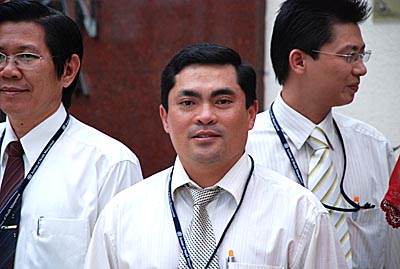 |
Mr.Tran Minh Quy is one of four Vietnamese partcipants attending the course. |
As an important part of the training course, the field visit was conducted for the participants to the district health centre of Gombak, a Kuala Lumpur suburb. At Gombak, the participants were divided into two groups with their major interests focussed on either malaria or dengue fever. This facilitated the participants the skills of situation analysis based on the real case studies together with the actual data. From the analyses, the participants could be able to suggest recommendations and suggestions for improving the malaria and dengue fever situations.
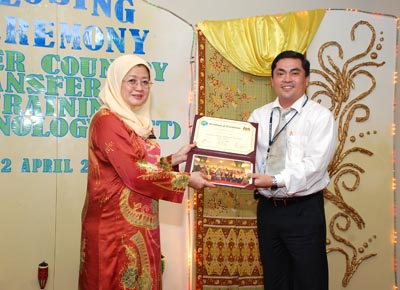 |
Deputy Minister of Health of Malaysia awarding the certificate to Mr.Tran Minh Quy. |
At the end of the course, two participants in the same country conducted the presentation of their proposals for country project in front of the panelists. The contents of the presentations were based on the real situations of malaria in participants' countries. The proposal "Strengthening the capability of communal health staff to manage malaria effectively in border areas of Central Vietnam" was highly evaluated, promising the sponsorship from concerning bodies.