In 2009, the Central Vietnam had many difficulties in malaria control activities. According to the statistics of 2009 against the same period of last year, malaria situation tended to increase in many areas. Although the IMPE-Quy Nhon and the regional provinces strengthened malaria control measures to restrict rate of deaths and prevent the increase of morbidity, death and outbreaks, malaria situation still continue to increase complicatedly.
On March 9th 2010, the workshop on reviewing malaria and parasitic diseases control in 2009 and deploying the workplan of Central Vietnam in 2010 was held in Dong Hoi city, Quang Binh province. The workshop evaluated malaria, helminthiasis and dengue control activities of 2009 to give priority measures in control activities for 2010. Participants to the workshop included Trinh Quan Huan, Deputy Minister of Health, Nguyen Dang, vice-chairman of the People's Committee of Quang Binh province, leaderships from the Department of Preventive Medicine and Environment (Ministry of Health), NIMPE, IMPE-Quy Nhon, IMPE-Ho Chi Minh city, Health Service; leaders and staff from provincial malaria stations/provincial centres of preventive medicine; representatives of malaria-endemic districts, rubber companies.
After receiving the opening by Dr. Trinh Quan Huan, Deputy Minister of Health, the workshop witnessed the presentations of reports on malaria control activities of 2009 and deploying the workplan for 2010 from Dr.Trieu Nguyen Trung, Director of IMPE-Quy Nhon, Dr.Le Thanh Dong, Director of IMPE-Ho Chi Minh, Dr.Nguyen Manh Hung, Director of NIMPE. Besides, the workshop received report presentations by representatives of World Health Organization (WHO) and provincial health services.
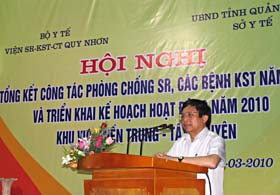 |  |
Dr. Trinh Quan Huan, Deputy Minister of Health in
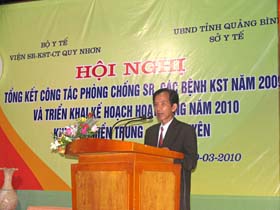
his opening speech at the workshop. | Dr. Trieu Nguyen Trung, Director of IMPE Quy Nhon in
his report at the workshop. |
According to the reports of 2009, in comparision with the same period of 2008, the whole country had 60,246 malaria patients, 0.73% up; 141 severe and complicated malaria cases (+37.59%), 11,355 cases of malaria parasites infection (+42.1%). Although health care sectors gave malaria control measures, malaria situation still tended to increase highly. In Central Vietnam, malaria indexes increased highly, with morbidity rate 14.61% higher, malaria parasite 55.72% up and severe and complicated malaria 32.94%, death from malaria 14.29% against the same period of last year. 9/15 provinces had higher death from malaria such as Phu Yen, Ninh Thuan, Gia Lai; 8/15 with increased rates of morbidity and 12/15 provinceswith increased rates of malaria parasites. Some of provinces with increased numbers of malaria morbidity and parasite rates were Gia Lai, Phu Yen, Binh Thuan, Quang Ngai, Dak Lak, Kon Tum, Binh Dinh, Khanh Hoa.
Besides, in the recent years, some kinds of helminthiasis appeared popularly such as Fascioliasis, Opisthorchis viverrini, soil-transmitted helminthiasis; especially Fascioliasis infection in herbivorous animals. Therefore, IMPE-Quy Nhon need to combine with the Department of Preventive Medicine and Environment (MoH), the provincial malaria control centres/Provincial centres for preventive medicine to survey reasons for the increasing number of Fascioliasis patients and demand early solutions.
To control malaria situation effectively, health care sectors need to enhance the quality of technical measures in the malaria control campaigns/activities for localities; strengthen epidemiological surveillance for high-risk provinces, remote areas; carry out management and treatment for malaria patients; consolidate and improve grass-roots health care network.
 |
Participants to the workshop. |
The Institutes of Malariology, Parasitology and Entomology, the provincial malaria control centres/Provincial centres for preventive medicine should concentrate on directing malaria control measures effectively for high-risk areas; carrying out indoor residual sprays and bednet impregnation for the local people; using the budget of malaria control program and of the Global Fund Project on Malaria Control effectively.