In order to evaluate and improve the quality of malaria diagnosis and treatment as well as to overcome and draw experience in lowering the malaria death rate, under the financial support of the WHO and technical expertise of the IMPE Quy Nhon, with the consent and assistance from the Provincial People's Committee and the Provincial Health Department of Gia Lai, the IMPE Quy Nhon held "Workshop on improving the quality of malaria diagnosis and treatment in Central Vietnam" in Gia Lai province.
The Workshop was held in Gia Lai province on 10-11 September 2010. Participants to the Workshop included The World Health Organization (WHO) in Vietnam, the National Institute of Malariology, Parasitology and Entomology (NIMPE), the IMPE-Quy Nhon and the IMPE Ho Chi Minh, the leaderships of the Provicial People's Committee and the Provincial Health Department of Gia Lai, the leaderships of the health departments and general hospitals of 15 provinces of Central Vietnam, of malaria control centres and centers for preventive medicine of 15 regional provinces, military medicine hospitals, communicable disease specialists, etc.
The Workshop listened the reports on the malaria situation in Central Vietnam and the quality of malaria diagnosis and treatment at all levels, analysed of the cause of deaths from malaria in the past years, and discussed problems in treatment. Also, the Workshop exchanged the updated information about diagnosis and treatment, antimalarial resistance and measures against this condition.
The chairman and secretariat discussed and brought some recommendations out to improve the quality of malaria diagnosis and treament, lowering malaria mortality in the coming years.
I. The Workshop Objective
1.1. Access the quality of malaria diagnosis and treament at hospital service lines.
1.2. Analyse the causes and risk elements leading to malaria mortality at levels of health-care services.
1.3. Discuss and share the information and experience in diagnosis and treament so as to lower death rate from malignant malaria.
1.4. Provide the information on "Guidance on malaria treament" issued by the MoH in 2009.
1.5. Update the information about the current antimalarial resistance, including the risk of malaria parasite resistance to artemisinin and its derivatives.
II. Some contents involving malaria diagnosis and treatment presented at the Workshop
1. The malaria situation - Challenges and difficulties in malaria control in Central Vietnam: Strategies and solutions (Dr. Trieu Nguyen Trung)
- The malaria situation in the world and Vietnam has developed complicatedly in recent times. In Vietnam, malaria mainly appears in the Central region where 80% of the country's mortality and 50% of the morbidity due to malaria concentrated in. In the five first months of 2010, in Central Vietnam, malaria cases raised by 24.7% and severe malaria cases increased by 57.14%
- The challenges and difficulties in malaria control:
+ The natural conditions facilitates the development of malaria (75% of the area is mountain and forests which closed up to flat country); the population of the malaria-endemic areas accounts for 50% that of the whole country, so the malaria morbility and mortality rate of this region makes up 50% and over 80% respectively against those of the whole country;
+ Huge number of mobile populations and free migrants (who migrate from the North to the Central in search of work, or go into the forest to work and sleep in the field-huts, cross Laotian-Vietnamese border, etc.); ineffective malaria control measures for these objects;
+ Grass-roots health networks remained a lot of restrictions (malaria patient management at grassroots level was not effective, microscopic sites had not carried out their ability yet, 30% of the microscopes were old or damaged, making the diagnosis and detection of malaria not be ensured).
+ The system of epidemic early prediction and surveillance was still not effective (the surveillance figures were passive and inexact; the ability of data analysis and processing was not good).
+ Malaria parasites can be resistant to highly-effective antimalarial drugs; artemisinin resistance can develop and spread, so high risk of malaria deaths remains, especially in the provinces of the West Highlands (there were 14 cases of malaria death in 2008 and 16 in 2009).
- The cause of increasing malaria patients and malaria deaths
+ Subjective cause:
There are no feasible and effective malaria control measures for mobilised people (people working in the forest, sleeping in the field huts, free migrants).
People have no awareness of self-protection as living in the malaria endemic areas, especially the rate of those using bednets was rather low; the termination of malaria transmission is complex and restricted, especially in the Laotian-Vietnamese border. Malaria patients were admitted to hospital late, making it difficult for diagnosis and treatment.
Grass-roots health networks are still not effective, microscopic points are unable to early detect and promptly treat malaria cases. The ability of emergency aid for severe malaria cases at district health care level is still limited.
+ Objective cause
Remote, deep-lying and border areas of Central Vietnam are all highly-endemic malaria ones with complex malaria epidemiological characteristics that are favourable for the natural transmission of malaria.
The varying weather and climate created favourable environment for the development of vectors and badly affected the effectiveness of the malaria control measures like residual insecticide spraying and bednet impregnation (storms, floods).
2. Evaluation of malaria death situation period 2007- 2009 (Dr. Ho Van Hoang)
- The Central Vietnam has high rate of malaria deaths against other regions. The analysis of the region's malaria mortality from 1976 to 2009 showed that the highest rate of deaths was in 1991 and also in this year the malaria elimination program of Vietnam was moved to the malaria control program with unlimited implementing period with the purposes of reducing malaria morbidity and mortality and no malaria outbreaks.
- Malaria deaths in Central Vietnam occur mainly from August to December. Some risk factors affect the rate of death such as gender (male higher than female), age (mostly those above the age of 15), ethnic groups, forest goers, free migrants, cases with cerebral malaria, etc. Most of these cases died before 24 hours.
- Some issues of concern: the quality of diagnosis and treatment at health-care levels were still not high; health communication and education were still not effective; no feasible control measures for mobilised people were available; the fund for reasearch had many restrictions.
3. The cause of malaria deaths in Gia Lai in 2009 (MA. Nguyen Ngoc Loi)
- Gia Lai is a severely-hit province of malaria with the existence of two main malarial vectors, malaria parasite P.falciparum makes up 90%, 28 communes are in hyper-endemic areas, 49% of its population are of ethnic minorities, bednet coverage is still low, the custom of making ceremonial offerings upon getting diseases remains. At some microscopic sites, the testing results weren't showed timely, making it difficult for early diagnosis. The equipments for first-aid at district health-care facilities didn't ensure the emergency of severe and complicated malaria.
- Themalaria mortality of the province period 2006-2009 is always higher than that of other provinces in the country. The analysis of malaria deaths in 2009 showed that most of these cases were in the habits of sleeping in the plot-huts without bed-nets, not taking drugs upon having fever, being hospitalised after 3 days of fever, being in deep coma beyond treatment ability.
- The analysis of all factors showed that these cases died before 24 hours, came to hospital when the disease condition became too serious beyond the ability of treatment, 3/3 cases (100%) were dead due to not sleeping under the bed-nets frequently, limited competence in detecting and dealing with malaria at district level, no effective malaria control measures for plot-hut goers.
- Proposed solutions: strengthening health communication and education, retraining communal health staff, improving microscopic sites, supervising and enhancing the malaria diagnosis regularly, providing RDTs for places with no microscope coverage.
4. Malaria situation and malaria death in 2009 in Phu Yen province (Dr. Lam Nhu Phan)
- Phu Yen has a population of nearly 900,000 with 50% of the population and 67 over 112 communes (59.8%) in the malaria-endemic areas. In 2009, there was an increase in malaria patients compared with 2008, with three deaths from malaria.
- The analysis of three malaria deaths showed that they are all male, from Kinh ethnic group, involved in the habits of going to work in the forest and sleeping in the field huts, usually not sleeping under the bed-nets; they were admitted late (after 3 days of fever) and 2 over 3 cases died before 24 hours; all these 3 cases were of cerebral severe P. falciparum malaria.
- Cause of these fatalities: 1 over 3 cases wasn't diagnosed timely; the patient was from mobilised groups who usually travel between areas in the months near the lunar new year's day so as to trade and exchange goods, or move about between plains and highlands without effective malaria control measures. The patients were admitted late after unsuccessful treatment at private health facilities, were made inexact initial diagnosis because of not thinking about malaria infection, died before 24 hours.
- Solutions: malaria control measures for mobile populations should be set up; annual training courses on malaria diagnosis and treatment at all levels are also needed.
5. Report on three patients of severe and complicated malaria and treating results at Cho Ray Hospital (Tran Quang Binh, M.D, Ph.D)
- Three cases of severe and complicated malaria were treated successfully with equipments and means at Cho Ray Hospital thanks to different principals in dealing with each malignant malaria case and close case monitoring.
- Experience drawn on from these three cases: severe and complicated malaria should be considered as a systematic disease with the complication on many organs and viscera, which threatens the patients' life due to late and ineffective treatment of severe malaria. Note to distinguish malignant malaria from meningitis (germs, viruses, etc.), encephalitis, coma for cause of metabolism, trauma in the head, cardiovascular accident, etc., shocks due to infection, volume reduction, myocarditis, etc., fulminant hepatitis, Leptospirosis, biliary infection, puerperal eclampsia, mental disorder, acute renal failure due to other causes, haemorrhage for other causes.
- Many evidents showed that the above cases with severe complications should be resuscitated actively. The common integrated infections unlike malaria includes Leptospirosis, viral hepatitis, encephalitis-meningitis which appear in the epidemiological areas of southern provinces. The high density of parasites is a prognostic factor, acute respiratory distress, shock, lactic acidosis, acute renal failure with an increase of kali in blood, acute pulmonary edema are the most serious complications. The respiratory distress is the major cause of fatality and the pathogenic mechanisms of acute pulmonary edema are usually due to humour excess or ARDS, surinfection or combination of the above causes. The acute pulmonary edema is often related to acute renal failure.
- To have a general analysis if needed, avoid exacerbating the disease condition, particularly to patients with multiple organ failure, etc. In clinical reality, malignant malaria is very complicated because many organs are injured. The injury to this organ can affect other organs more or less; for example, jaundice aggravates the conditions of acute renal failure, decreases coagulation factors, coagulation disorder, haemorrhage and all of these worsen the situation of available respiratory distress, leading to coma and brain complications.
- Immediate treatment should be carried out together with supportive measures so as to reduce mortality from malaria. Water, electrolysis, acid-base balance are very important factors in supportive treatment to prevent the occurance of other complications. The situation of humour excess facilitates the development of pulmonary edema at special level to patients with acute renal failure at no-urinary stage. Acute renal failure is very common and serious, but with timely diagnosis and rational direction of dialysis and kidney replacement death rate will be improved. The functions and responsibilities must be defined clearly.
- Thrombocytopenia also occur in malaria, but if there is a sign of jaundice, just think about malaria; on the other hand, cerebral symptom occur in dengue, which can confuse dengue with malaria.
- Some common faults in malaria diagnosis and treatment: wrong diagnosis of respiratory insufficiency (acute pulmonary edema, ARDS, pneumonia due to inhalation, metabolic acidosis); failure in shock control and wrong supportive therapies: Corticoides, Heparine, Manitol.
- Three health levels with different conditions and equipments for diagnosis and treatment: peripheral level (health stations of communes, hamlets), district and precint level (hospitals of districts and precints), central or provincial level (central or provincial hospitals)
- The standards for transferring patients to higher levels, the needs for all levels, different standards for each level based on clinical diagnosis, feasible and easily-applied equipments for active treatment and care.
- Recommendations: at grassroots health level: malaria patients must be given efficacious antimalarial drugs (artesunate TM or TB or anus place) before transferring to higher levels; district hospitals just should admit cases with slight complications and early transfer other cases after providing specific-drugs; provincial hospitals admit cases with mild, moderate and severe complications if enough equipments for emergency resuscitation are available; hospitals at central level with enough medical equipments and conditions admit all cases with all complications. The competence of early diagnosis, timely distinction diagnosis and effective treatment of malaria is needed to strengthen.
6. Malaria situation and malaria death in Ninh Thuan province (Dr. Ba Van Chinh)
- Ninh Thuan belongs South Central of Vietnam with about 25% of its population living in malaria-endemic zones (around 152,539 people). The number of malaria cases was about 1,623 (2009), of which 28 was of severe malaria and 3 of malaria mortality, in comparision with 2008 malaria patients reduced by 2.81% (1,623/1,670), severe malaria increased by 75% (28/16) and malaria death raised 1 case (3/2).
- The cause of malaria deaths: the people's awareness and knowledge about malaria are poor, patients don't come to health facilities as getting malaria, buy and use drugs by themselves, just come to hospital after complications occured, resulting fatal due to late admission. Health staff network is still deficient and weak, concurrently carries out many health programs, so the activities of disease monitoring and detection havenot been implemeted actively and closely.
- Proposed solutions: provide antimalarial drugs for hamlet health staff to serve the prompt detection and treatment of malaria under the regular instruction and supervision of communal medical staff; strengthen the mass communication and education on malaria control; distribute impregnated bed-nets and hammocks to the objects who frequently till and sleep in the field-huts; enhance the management of mobilised populations so as to plan the activities of examining blood smears for the detection of malaria parasites and providing drugs for stand-by treatment; held traning courses on improving knowledge of malaria diagnosis and treatment at all levels, particularly update the rudiments of emergency resuscitation in case of severe malaria for all hospital lines.
7. Malaria diagnosis and treatment at the levels of health-care in Central Vietnam (Dr. Huynh Hong Quang)
The results of malaria diagnosis and treatment period 2007-2009 showed that most of malaria cases were diagnosed and treated in compliance with the Guidance of the Ministry of Health 2007.
- At communal level: not be active in detecting disease; the blood smear detection at hamlets and villages wasn't really effective, just dealt with blood smear norms of each month; using quick-diagnosis tests in spite of many available microscopic sites; not be unanimous in or misunderstand the concepts of drug provision for stand-by treatment and suspected case (clinical malaria); the statistical reports often confused the cases of stand-by treatment and of clinical malaria; clinical malaria cases were usually tested only once; the preservation of Paracheck P.f and testing resuts when using it werenot correct at grassroots level. Many communal health facilities abused the distribution of stand-by treatment drugs in order to salvage an amount of drugs about expiring their best-before date; distributed many different kinds of medicines for stand-by treatment (although the new regimen 2009 had specifed what drugs were allowed to use); provided insufficientdoses for stand-by treatment (such as Artesunate, Chloroquine, Arterakine); the proportion of out-of-regimen treatment was very low (3.2%); some regimens were changed arbitrarily without complying with the MoH's guildlines in 2007, 2009; 100% of the test results of treated cases werenot be assessed and monitored before, during and after treatment; unclearly understood the treatment purposes of eliminating hypnozoite and gametocyte, resulting incorrect practice.
- At district level: the rate ofblood smear examination was just of 87.68%, of wrong and missing examination 12.32%; the test results just showed 'negative' (-) or 'positive' (+), not counted the density of malaria parasites, making it difficult to predict and monitor the disease development; blood examination was carried out only once to diagnose a clinical malaria case (76%); at some microscopic sites, health staff just used RDTs instead of examining blood smears. 95% of malaria cases were treated in compliance with the regimen, especially treament based on 'empirical' regimen 3%; overuse of Artesunate vial (a hospital was found that 100% P. falciparum malaria cases used Artesunate vial in 5-7 days); 3.42% used incorrect form of medicines when patients had pathological signs (diarrhea, vomiting, immunodeficiency HIV/AIDS); 92% were monitored treatment results (through testing) upon using drugs, 6.5% weren't monitored during the treatment and before discharging from hospital; errors in failure access/ malaria parasites' resistance to Artesunate vial (in 2 hospitals) and to Arterakine (in 3 hospitals); mistakes in monitoring treatment result - just using RDTs (in 2 hospitals).
- At central and provincial levels: blood smear examination with parasite density count achieved only 5% and mostly 95% of the examination stopped at density evaluation by the plus sign (+). The blood smears of clinical malaria cases were examined just once (36%); in some laboratories equipped with microscopes, the staff still used RDTs mostly; many severe-diagnosed cases didn't meet enough criteria to diagnose as severe, on the contrary, many cases with sufficient criteria were diagnosed as benign. Presently, many malaria cases with severe anemia and thrombocytopenia are often mistaken for dengue, so not being designated for blood smear examination, leading to miss out disease.
- Testing activities: many microscopes were unusable (9.8%), especially at communal level because their lens, coarse focus, fine focus, slide were damaged. Some microscopic sites (5.7%) werenot in operation because no technician was available; the microscopic maintenance wasnot good; although having microscopes, the detection and diagnosis in many places (10.6%) mainly based on RDTs; the general error rate of microscopic examination of malaria parasites at the levels of commune, district and province was 11.2%.
- Some suggestions:
+ Conducting microscopic examination of malaria parasites to all cases with fever as well as to suspected cases of malaria; counting malaria parasites in blood to monitor the disease;
+ Not overusing injectable Artesunate because it is also monotheraphy; limiting the infection day (about 1-2 days), then changing to oral medicines. The record of treament failure must rely on scientific basis.
+ Not overusing RDTs when microscopes are available.
+ In malaria treatment, there is a need to diagnose according to criteria, consider clinical malaria cases; pay attention to specific and symptomatic treatment; ensure enough number of drugs at health facilities, especially Artesunate vial, avoid the situation of taking out-of-date medicines.
8. Antimalarial resistance in the the world and Viet Nam (Dr. Huynh Hong Quang)
- The report gave a general history of the first resistance of antimalarial drugs extracted from herbs and synthetic. The emergence of artemisinin-resistant parasites on Cambodia-Thailand border will spread to neighbouring nations seriously; artemisinin resistance can frustrate one of the key phases of malaria control, etc.
- Confronted with this situation, WHO spent 22,5 million dollars from B & M Gates Foundation to plan the containment of artemisinin-resistant parasites, conduct the studies for clarifying evident-based science; effectively monitor and manage in the strategies.
- And it's also necessary to emphasise early diagnosis and appropriate treatment, decrease medicine pressure, choose optimal vector control measures, intentionally focus on mobile groups, not absolutely use Artemisinin or Artesunate monotherapy, avoid the drug treatment without enough doses; exclude substandard and counterfeit medicines;
- The situation of CQ-resistant P. vivax is happening in the world and is still a sensitive problem in Viet Nam; several studies showed that the time of breaking off fever and malarial parasites lasts longer than before.
- There are some changes and modifications relating to the evaluation of current antimalarial therapeutic efficacy, especially advanced techniques.
9. Several different points in the new regimen of 2009 compared with that of 2007 (Dr. Ho Van Hoang)
- Changes in some terms related to detection, diagnosis and treatment: malarial parasite density, have to do it again after an interval of 8 hours if the previous test result is negative, rapid diagnostic tests-RDTs, antimalarial medicine, designation of primaquine.
- These changes is generally more obvious and specific, helping to direct the levels of health-care more clearly. The new guildines also give standards of designation of kidney change, evaluation of treatment failure.
- The different change in malaria treatment 2009 is using artemisinin-based combination therapies (ACTs) instead of monotherapy.
- Besides, the dosages of primaquine were also changed so as to be in accord with the WHO's recommendations (therapeutic course of 14 days with 2 tablets per day instead of 10 days with 4 tablets per day).
10. Usage of stand-by treatment medicine in mobile groups (Dr. Ho Van Hoang)
- In spite of decreased malaria morbidity and mortality, the risk of malaria outbreaks is still high, especially in the community of forest and plot-hut goers that medical services find hard to access or manage; disease pathogen and spreading vectors are still exist.
- Control measures for these groups have not been effective such as indoor residual spraying and bednet impregnation for vector control, but they sleep in the field huts and not bring any bednets. Therefore, if they get malaria, the transport and emergency are very difficult; and risk of malaria deaths will be very high.
- Rate of getting antimalarials for self-treatment was 55.64%, drugs for self-treatment included 55.22% of artesunat, 30.79% of chloroquin and 15.59% of Arterakin. Rate of getting antimalarials in female was 85.90%, and in male was only 34.24% ; rate of getting antimalarials in the people of Kinh ethnic group (81.25%) was higher than those of Bana group (38,31%).
- The people getting antimalarial drugs for self-treatment at village health sectors was 62.77%, and at communal health sectors was 37.23%.
- There will need to be increased emphasis on the strategies of using antimalarial drugs for self-treatment in accordance with every area, and it is also needed to discriminate between terms "Self-treatment" and "Standby treatment".
III. Reports of the representatives and experts on malaria treatment
1. The report of Prof. Bui Dai on experience of severe and complicated malaria control and treatment
- The management of patients whose infection changes from uncomplicated malaria into malignant malaria with the aim of decreasing rate of death is very important, especially in diagnosis and in treatment. Malaria morbidity has generally decreased, but cases of malignant malaria have increased, and rate of uncomplicated malaria cases turning into malignant malaria has also increased.
- Research risk of causing complicated malaria and deaths to treat more effective, especially risk of uncomplicated malaria to malignant malaria (with symptoms such as headache, malaise, insomnia, be afraid of light, primary malaria, etc).
- To identify acute respiratory distress before diagnosing to discriminate malaria.
2. Assoc.Prof. Nguyen Xuan Thao (Tay Nguyen University)
- The workshop was presented and updated the new information on malaria diagnosis and treatment, provide the useful knowledge for the training activities.
- Antimalarial drugs with the orgin of medicinal herbs have stable therapeutic efficacy while the efficacy of generic antimalarials lasts shorter.
3. Dr. Ta Thi Tinh (NIMPE)
- In malaria diagnosis, epidemiological factor is very important, especially in provinces with low rate of decreasing malaria morbidity (the Southwest Vietnam); however, in these areas, dengue fever epidemic are emerging, so the medical staff often concentrate on diagnosing dengue fever and they forget to take blood slides for malaria parasite examination.
- With clinical malaria, the medical staff often treated by different therapies, not according to the guidance; sometimes they abused artesunate injection for other reasons. Therefore, the management of using drugs needs to have suitable mechanisms.
- The artemisinin resistance of ACTs: require the levels of health-care service to monitor the drug resistance in both clinical treatment and blood smear examination.
4. MA. Luong Truong Son (IMPE-Ho Chi Minh city)
- In 2009, 8/11 cases of malaria death in the South-Lam Dong were in malaria-endemic areas.
- Some of areas had high risk of malaria recrudescence, and hypo-endemic malaria areas need to be provided with suitable control measures.
- Provide RDTs to high-risk areas and areas of low malaria prevalence to detect malaria patients early.
5. Dr. Doan Van Hau (speciality 2) (General Hospital of Phu Yen province)
- To prevent cases of malignant malaria, fever cases should be taking blood sample for the disease detection like other communicable diseases; activities of diagnosis and treatment need to be equipped basically.
- Organise the workshops, the training courses to update the information on malaria diagnosis and treatment for health services, especially hospital service routes.
- The message "fever cases going to health services should be examined blood smears for malaria parasite detection" is very necessary for medical staff at present.
6. Dr. Mai Xuan Hai (speciality 2) (General Hospital of Gia Lai province)
- Malaria situation is decreasing, so the medical staff often neglect it and direct to other diseases.
- The treatment of complications and symptoms are very important. The means for emergency aid need to be equipped and supplemented better.
7. Dr. Ho Dinh Phuoc (Army Institute 13, Military Region V)
- Military Region V is long and wide with many highly-infected areas, the armed services mainly work in severely-hit areas; especially forces living with the people in border areas (force 133) had high risk of malaria infection.
- Inpast ten years, malaria situation has been improved and controlled effectively. There was no death from malaria.
- The patients being admitted to hospital by having fever often were tested blood slides for malaria parasites.
- At present, many preventive measures need to be carried out better to monitor the situation of counterfeit and ineffective drugs.
8. Dr. Tran Ngoc Hung (General Hospital of Quang Nam province)
- Most of malaria deaths of Quang Nam were the people working in gold mines where malaria is highly prevalent.
- Patients often take febrifuge when having fever without taking antimalarial drugs.
- Many cases of malaria were treated unsuccessfully with ACTs in General Hospital
9. Dr. Nguyen Duc Hao (General Hospital of Dak Nong)
- Malaria deaths in the hospital are often due to severe complications.
- Provide antimalarial drugs for self-treatment, but the people often forget or don’t take it as going to the forest.
- The quality of microscopic points has not really been effective and the technical staff were unspecialized, limiting in the operation.
10. Dr. Tran Tan Vinh (Vietnam-Cuba General Hospital of Dong Hoi)
- At present, the quality of diagnosis and treatment are improved, but the knowledge and information on malaria is not updateded frequently.
- Organise the training courses and epidemiological surveillance to enhance the quality of malaria diagnosis and treatment.
11. Dr. Nguyen Vo Hinh (the provincial centre for malaria control of Thua Thien-Hue)
- To contain malaria deaths, the diagnosis and treatment need to be carried out early and promptly at grass-root levels.
- Provide Artesunate vial to commune routes to decrease rate of deaths.
- Provide RDTs for grass-roots health network to decrease rate of malaria morbidity and death.
12. Dr. Tran Cong Dai (Expert of WHO in Vietnam)
- The role of health facilities in malaria control activities was still weak, malaria deaths are due to not providing antimalarial drugs for self-treatment.
- When patients having fever go to health services, they have to be examined blood slides for malaria parasites according to the requirement of the programme. Microscopes need to be considered as the gold standard for malaria diagnosis.
- The WHO is also worried about the situation of artemisinine resistance. Nowadays, private health facilities sell artesunate monotherapy for malaria treatment prevalently.
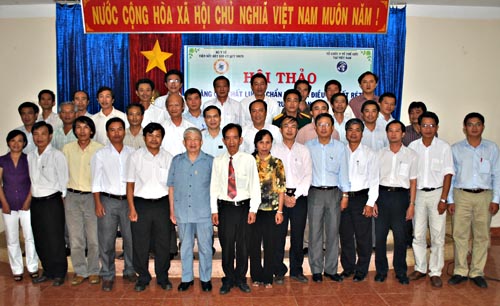 |
Participants to the Workshop |
IV. Recommendations of the Workshop
1. Diagnosis
- Blood slide examination for detecting malaria parasites for all cases with fever and suspected malaria cases. The blood smear examination must show the resuts of parasite density count to help monitor the disease. Rapid diagnostic tests (RDTs) are sold widely in pharmacies, so recommendations should be given to patients. Not overuse RDTs if microscopes are availabe.
- Early detection of malaria cases in the community; health networks at grass-root levels (health facilities of districts, communes, hamlets, villages) need to manage mobilised populations (people going to work in the forests, sleeping in the field huts).
- Maintain the activitites of microscopic points; provide and supply the equipments for early detecting malaria patients. Enhance the technical expertise and skills of the communal medical staff through training courses.
- Monitor the operation quality of microscopic points, especially in communes.
- In diagnosis, pay attention to accompanied complications of severe malaria (bacterial contamination, respiratory and renal failure, etc.)
2. Treatment
- The medical staff treat malaria patients according to the guidance of Ministry of Health in 2009.
- Not provide and use artesunate monotherapy, have to use artemisinin-based combination therapies (ACTs)
- Artesunate injection shouldn't be abused for malaria patients who are able to take medicines.
- Provide emergency aid for cases of severe and complicated malaria by artesunate injection before moving to higher leves of health-care.
- Attach special importance to resuscitationtreatment so as to lower the rate of deaths from complications of malaria.
- Distribute malaria drugs for standby-treatment to mobilised people (people working in the forest, sleeping in the field huts, crossing the borders) with the specific instructions and management to avoid waste of drug and risk of drug resistance .
3. Health communication and education
- Strengthen health communication and education for malaria control, especially direct at households with members woking in the forests, crossing borders.
- Train the medical staff of villages, hamlets to enhance the knowledge on malaria control.
- Organise the workshops to update the information of malaria diagnosis and treatment frequently.
4. The equipments and antimalarial medicines
- Deliver supplementary instruments and equipments for communal microscopic points to enhance the quality of microscopic examination of malaria parasites.
- Supply RDTs for communes without microscopic points.
- Provide artesunate injection for communal routes to carry out emergnecy aid for severe and complicated malaria cases, then moving to higher routes to decrease malaria mortality rate.