In the past years, malaria has gradually been rolled back, malaria indexes in Vietnam decreased distinctly; however, the Central Coastal, the West Highland and Southeast Vietnam are still severely-hit regions of malaria with 70% of morbidity rate and most of deaths. In order to evaluate and improve the quality of malaria diagnosis and treatment as well as decrease proportion of death from malaria, under the financial support of World Health Organization (WHO), the IMPE Quy Nhon held "Workshop on improving the quality of diagnosis and treatment of malaria in Central Vietnam" in Gia Lai on 10-11 September 2010.
Participants to the workshop included experts on infectious diseases in Vietnam, the representative of WHO, leaderships and specialists of malaria research department of NIMPE, IMPE-Quy Nhon and IMPE-Ho Chi Minh, leaderships of Tay Nguyen University, the provincial malaria control centres/provincial centres for preventive medicine, Army Institutes in Central Vietnam; besides, there were the provincial radio and television station of Gia Lai and the national television station in the West Highland.
The aim of the workshop is to give the causes and solutions to decrease mortality rate of malaria, improve the quality of malaria diagnosis and treatment at hospitals and centres, assess the situation of drug-resistant malaria and the measures of preventing malaria parasites resistant to highly-effective drugs.
In his directive speech at the workshop, Dr. Trieu Nguyen Trung appreciated malaria situation of Central Vietnam. At present, malaria situation confronts with many difficulties in rate of morbidity and death from malaria, especially mobilised people. In 2009 and first half of 2010, malaria situation has happened complicatedly, so it is necessary for the workshop to discuss and give control measures efffectively.
The workshop received specialized report presentations on malaria situation, difficulties in malaria control activities, strategies and solutions for malaria control of Dr. Trieu Nguyen Trung, Director of IMPE-Quy Nhon; evaluating rate of deaths from malaria from 2007 to 2009, the use and management of anti-malarial drugs for self-treatment of mobilised people in Central Vietnam, the changes of the guidance on malaria diagnosis and treatment in 2009 compared with previous years of Dr. Ho Van Hoang, vice-director of IMPE-Quy Nhon; reports on clinical cases and experiences for treatment of severe and complicated malaria of Dr. Tran Quang Binh, Head of Isolation Department of Cho Ray Hospital, Ho Chi Minh city; diagnosis and treatment of malaria in Central Vietnam, drug-resistant situation in the world and in Vietnam of M.Sc Huynh Hong Quang, Head of Malaria Research Department, IMPE-Quy Nhon. Besides, the workshop also received discussions from experts such as Prof. Bui Dai, Dr. Tran Quang Binh; representatives of NIMPE and IMPE-Quy Nhon; provinces with high rate of malaria (Gia Lai, Dak Lak, Phu Yen, Ninh Thuan); general hospitals; army hospitals; the provincial malaria control centres/ provincial centres for preventive medicine of Central Vietnam.
According to the evaluation at the workshop, malaria situation tended to decrease, but risk of malaria is still high in the Central coastal areas, the West Highlands and the Southeast area with above 70% of morbidity and 90% of death from malaria. High malaria morbidity and death rates were mainly due to changeable weather which created favourable conditions for the development of vector-borne diseases, mobilised people (people working in the forest, sleeping in the field huts and crossing the borders).
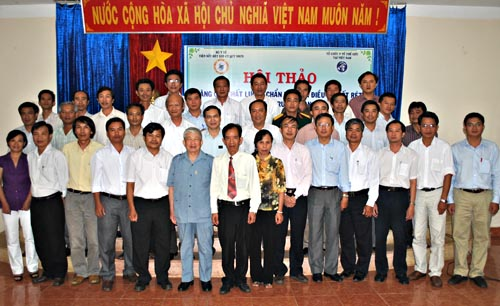 |
Participants to the workshop |
According to experts, in order to restrict rate of malaria death, the prevention of severe and complicated malaria is very important, so prompt detection, diagnosis and timely treatment need to be priority. Besides, impoving the quality of diagnosis and treatment for malaria patients, providing drugs for self-treatment are necessary requirements to restrict rate of malaria morbidity and death.The workshop indicated the different points of the guidance on diagnosis and treatment of malaria 2009 against former ones and requested health centres to carry out seriously in accordance with the training material of Ministry of Health (MoH). The workshop also updated the knowledge on diagnosis and treatment of malaria. Besides, the experience of army units also indicated that soldiers often go through malaria-endemic areas, risk of infecting malaria is very high, but they applied control measures effectively to prevent from infecting.
During the workshop, the national subcommittee of malaria treatment held the extended meeting with the attendance of the experts and representatives of WHO in Vietnam, leaderships of the Institutes to assign the activities, at the same time unify the content of recommendations to MoH and National Malaria Control Project so that the workshop could give specific activities for improving measures of malaria diagnosis and treatment in particular and malaria control in general.