On October 16, 2009, the National Institute of Malariology, Parasitology and Entomology (NIMPE) and IMPE-Quy Nhon held the training course and deployed malaria epidemiological stratification for intervention of 2009 for 15 provinces of Central Vietnam in Quy Nhon city, Binh Dinh province.
The aim of the malaria epidemiological stratification for intervention of 2009 is to review the total malaria areas in the whole country to propose appropriate malaria control measures for every area and orientate malaria control strategy for the next 5 years (2010-2015). Based on the existing natural conditions, indicators of main malaria vectors and levels of malaria prevalence, the target of this malaria epidemiological stratification for intervention is to construct the stratification map of malaria epidemiology with commune (ward) being the unit of stratification, and to propose suitable malaria control measures corresponding to each malaria zone. Accordingly, the stratification of interventional malaria epidemiology will be unified and deployed in the whole country from now till the end of 2009 for field operations in 2010. The fund of the training course is supported by WHO and the fund of stratification activities is supported by Vietnam Global Fund Malaria Control Project.
The training course on malaria epidemiological stratification for intervention
Provincial and central levels
For the training course on malaria epidemiological stratification for intervention in Central Vietnam, the participants were composed of 70 staff specified in Epidemiology, Entomology, Laboratory technology and one accountant of IMPE-Quy Nhon; and 50 staff from provincial malaria control centres/ provincial centres for preventive medicine. Upon finishing the training course, these participants will directly carry out the malaria epidemiological stratification at localities. The training course also welcomed the participation of the leaders from NIMPE and IMPE, and staff from the Global Fund Malaria Control Project.
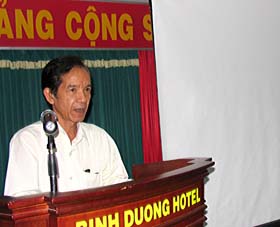 |  |
Dr. Trieu Nguyen Trung-Director of IMPE Quy Nhon
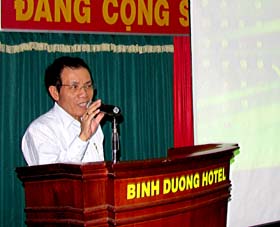
in his speech at the Training course. | Assoc.prof. Le Xuan Hung - Deputy Director of NIMPE
in his speech at the Training course. |
The training course focused on methods, standards of stratification, strategies and interventional solutions for every epidemiological zone; plans of conducting the stratification; forms and methods of collecting data; instructions on financial procedures, discussions and recommendations, and agreement among groups on schedule of implementing stratification after the training course.
District level
After being trained at the IMPE, the staff from the provincial malaria control centres/ centres for preventive medicine will carry out the retraining for the staff of district health centres; especially focusing on the methods of stratification and collecting retrospective data of malaria between 2004-2008.
Implementation
In order to keep the rate of progress, the IMPEs are assigned to implement the malaria epidemiological stratification for intervention for the area of their responsibility. Agreably, the IMPE-Quy Nhon will be accountable for 15 provinces of Central Vietnam in terms of epidemiological stratification.
 |
Participants to the Training course. |
Every institute will establish a technical steering unit with 4 members including a director, a vice-director in charge of expertise, an epidemiologic staff and an accountant. The steering unit has the duties of stratifying the area of every zone, assigning, coordinating and supervising the overall activities regarding the data collection, modification and completion at the provinces in charge. Afterwards, it has to submit the completed data to the VGF Malaria Project.
According to the agreed plan, it is estimated that by the end of 2009, the malaria epidemiological stratification for intervention will be completed right before the workshop on informing the results of the malaria epidemiological stratification to be held at the beginning of 2010.