In 2010, the malaria indexes (malaria morbidity, malaria parasites, severe and complicated malaria and malaria mortality) in Central Vietnam decreased distinctly and no malaria outbreaks occurred; however, with the specific malaria characteristics of the region, these indexes haven't still showed a sustainable decrease and the risk of the epidemic can occur highly, so many priority measures are needed to be carried out actively to prevent the outbreaks from occurring in this region in the coming years.
Malaria is a vector-borne disease with high rate of mortality and morbidity; the spread of the disease and the possibility of the outbreaks can cause serious consequences for the health of the community. From 2000 to now, lots of good results have been achieved in decreasing rate of morbidity, mortality and epidemic from occurring; however, in Central Vietnam, the number of morbidity, mortality made up near 50% against that of the whole country, mainly in mobilised people. The awareness of the people living in malaria-endemic areas is still low, the quality of health networks has not been improved; besides, changeable weather created favourable conditions for the development of vector-borne diseases.
Malaria situation of Central Vietnam in the period of 2000-2011
Compared malaria indexes in the period of 2000-2011
Compared malaria indexes of Central Vietnam 2010 with those of 2000, all of malaria indexes decreased distinctly with malaria morbidity 81.67% lower, severe and complicated malaria 87.6% down, malaria parasites 78.69% lower and malaria deaths 93.28% down; especially no outbreaks occurring.
Malaria situation in recent 5 years (2006-2010)
Compared malaria indexes of Central Vietnam in recent 5 years, most of malaria indexes of 2010 decreased with malaria mobidity (-44.46% against that of 2006, -4.61% against that of2009), severe and complicated malaria (- 42.43% against that of 2006, -3.54% against that of 2009), malaria parasites (-25.97% compared with that of 2006, +10.68% compared with that of 2009) and malaria death (-68% compared with that of 2006, – 50% compared with that of 2009); especially mortality rate gained the lowest reduction against that of previous years.
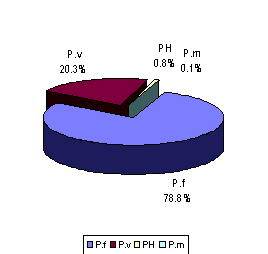 | 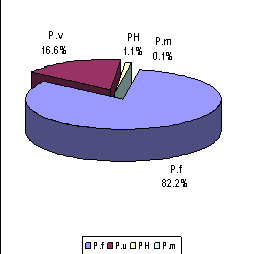 |
The proportion of malaria parasites period 2000-2005.
|
The proportion of malaria parasites period 2006-2010.
|
Malaria situation of Central Vietnam in the period of 2006-2010
Indexes | 2006 | 2007 | 2008 | 2009 | 2010 | % (+/-) 2010/2006 | % (+/-) 2010/2009 |
Morbidity | 38351 | 25893 | 19485 | 22331 | 21302 | -44.46 | -4.61 |
Severe and complicated cases | 192 | 97 | 85 | 113 | 109 | -43.23 | -3.54 |
Mortality | 25 | 13 | 14 | 16 | 8 | -68.00 | -50.00 |
Malaria Parasites in % | 1.54 | 0.93 | 0.69 | 1.03 | 1.14 | -25.97 | 10.68 |
The difficulties in technical activities of malaria control
P.falciparum making up the majority of malaria parasites
During the periods of malaria control activities (2000-2005) and (2006-2010), P.falciparum is a kind of parasites causing malignant malaria, deaths and can be resistant to many kinds of antimalarial drugs (Chloroquine, Amodiaquine, Fansidar, etc.). P.falciparum always made up the majority of malaria parasites (79-82%), which is very difficult for treatment of malaria and reduction of malaria mortality in Central Vietnam.
The causes of malaria deaths not being remedied
In 2010, there were only 8 malaria deaths, decreasing by 50% compared with previous years; however, these indexes are not sustainable and can increase in following years.
The analysis of 51 cases of malaria mortality (2007-2010) showed that the causes of death has still not been improved; these cases were mostly malefolks above the age of 15 (70-75%), forest goers (37-77%), patients given late admission after unsuccessful private treatment (62-92%). Most of malaria deaths were confirmed to have malaria parasites in blood, multivisceral complications (31-37%), cerebral malaria and some of other complications (62-69%); these cases died before 24 hours due to serious complications, beyond the hospitals' emergency ability (40-50%), this proved that the detection, diagnosis and treatment of malaria at some hospital haven't been timely.
The analysis of malaria death in the period of 2007-2010
TT | Index of analysis | 2007 | 2008 | 2009 | 2010 |
Death | % | Death | % | Death | % | Death | % |
1 | Cases of malaria death | 13 | | 14 | | 16 | | 8 | |
1 | Gender | Male | 9 | 69.23 | 12 | 85.71 | 14 | 87.50 | 6 | 75.00 |
Female | 4 | 30.77 | 2 | 14.29 | 2 | 12.50 | 2 | 25.00 |
2 | Age | <=15 | 4 | 30.77 | 2 | 14.29 | 3 | 18.75 | 1 | 12.50 |
>15 | 9 | 69.23 | 12 | 85.71 | 13 | 81.25 | 7 | 87.50 |
3 | People | Kinh | 4 | 30.77 | 9 | 64.29 | 9 | 56.25 | 5 | 62.50 |
Ethnic minority | 9 | 69.23 | 5 | 35.71 | 7 | 43.75 | 3 | 37.50 |
4 | Hospitalization | <=3 days | 7 | 53.85 | 1 | 7.14 | 3 | 18.75 | 3 | 37.50 |
>3 days | 6 | 46.15 | 13 | 92.86 | 13 | 81.25 | 5 | 62.50 |
5 | Mobilised people | Working inthe forest, sleeping in the field huts | 10 | 76.92 | 10 | 71.43 | 6 | 37.50 | 8 | 100 |
Free migrant | 2 | 15.38 | 1 | 7.14 | 3 | 18.75 | 0 | 0 |
6 | Malignant malaria | Visceral malaria | 6 | 46.15 | 10 | 71.43 | 5 | 31.25 | 3 | 37.50 |
Cerebral malaria | 7 | 53.85 | 4 | 28.57 | 11 | 68.75 | 5 | 62.50 |
7 | Time of death | <=24 hours | 8 | 61.54 | 6 | 42.86 | 10 | 62.50 | 4 | 50.00 |
> 24 hours | 5 | 38.46 | 8 | 57.14 | 6 | 37.50 | 4 | 50.00 |
8 | Place of death | Provincial hospitals | 13 | 100.00 | 12 | 85.71 | 13 | 81.25 | 5 | 62.50 |
District hospitals | 0 | 0.00 | 1 | 7.14 | 3 | 18.75 | 1 | 12.50 |
Transfering to higher levels | | | 1 | 7.14 | 0 | | 2 | 25.00 |
9 | Blood exammination | Malaria parasites(+) | 13 | 100.00 | 14 | 100.0 | 16 | 100.0 | 8 | 100 |
| | | | | | | | | | | |
| | | | | | | | | | | | |
Major vectors recovered and presented in most malaria-endemic areas
In the past years, because of this condition, the malaria control measures (residual insecticide spraying, bed-net impregnation) were limited in the areas with low malarial indexes and also showed an ineffective protection for mobilised groups; the two major vectors of malaria transmission (An.minimus, An.dirus) and some secondary vectors (An.aconitus, An.jeyporiensis, An.maculatus) have tended to recover and present in nearly all areas of malaria, while the pathogen is still existing popularly in the community, which increases the high risk of spread and outbreaks of malaria.
According to the analysis of the vector surveillance data (2006-2010), the number of surveying points with the presence of major malaria vectors was high: 8 over 9 points had An.minimus and 4 over 9 points had An.dirus (in 2009); 11 over 13 points had An.minimus and 7 over 13 points had An.dirus (in 2010). The average percentage of Anopheles mosquitoes infected with malaria parasites (sporozoite, gametocyte) is of 0.8%; the multi-species phenomenon in main vectors (An.minimus and An.harrizoni) makes it difficult for the taxonomy of main disease-transmitting mosquitoes in localities.
Percentage of mosquitoes infected with malaria parasites in the provinces
Region | Province | Number of tested mosquitoes | Results | Rate (%) |
P.falciparum | P.vivax |
Central Coastal | Quang Nam | 107 | 1 | 0 | 0.94 |
Phu Yen | 193 | 1 | 1 | 1.04 |
West Highlands | Gia Lai | 114 | 1 | 0 | 0.88 |
Dak Lak | 202 | 1 | 0 | 0.50 |
Total | 616 | 4 | 1 | 0.81 |
Prior solutions for malaria control in the next 5 years (2011-2015)
Priority over malaria prevention for mobilised populations
Finding solutions for existing problems such as shortage of bed-nets, low rate of bed-net usage, free migrants and mobile populations, people going and sleeping in forest and crossing borders; late detection and diagnosis, improper treatment, incomplete coverage of vector prevention; unsustainable quality of vector control measures, difficuties in accessing health services/malaria control for people living in deep-lying and remote areas and shortage of resources (including manpower and funding for implementation).
The top priority over mobilised groups in malaria prevention in Central Vietnam at present are to continue rolling back malaria, develop the health communication and education and socialization of controlling malaria, parasitic and insect-borne diseases widely in the community; to enhance the direction and supervision of epidemic situation in the severely-hit areas so as to promptly detect, tackle and forecast epidemics; to focus on effective malaria control for free migrants, forest goers, people crossing borders and working in the key economic project areas of the State.
Close control of drug-resistant malaria
Monitoring and evaluating the malaria parasites (P.falciparum, P.vivax) resistant to Artemisinine and Chloroquine and the therapeutic efficacy of the current antimalarial-drugs by the techniques of in vivo and in vitro. Studying the molecular biology of drug-resistant parasites, distinguishing between recurrence and reinfection, studying drug-resistant molecular mutation by PCR and other molecular biology techniques. Researching on the epidemiology of drug resistance and mapping the distribution of drug resistance in Central Vietnam. Building the comprehensive monitoring system of malaria resistance from the central level (institutes of malariology, parasitology and entomology), provincial level (malaria control centres/centers for preventive medicine, provincial/regional general hospitals), district level (district health care centres/district hospitals), to communal level (communal medical stations, communal microscopic points, areal general clinics). Training health staff at institute level in improving drug resistance techniques (continuous culture, in vitro, BioAssay, pharmacokinetics, molecular biology) and those at provincial and district levels in transferring the techniques of drug-resistance evaluation. Providing the equipments to controlling drug resistance: laboratories for drug resistance research at institute and provincial levels, test kits for assessing drug resistance in the field.
Strict control of malarial vectors
Monitoring the changes in malaria vectors related to the change of natural and socio-economic environment (species composition, density, behavior and role of disease transmission of the main vectors), the recovery of the major vectors (An.minimus, An.dirus) in the history against malaria. Assessing the sensitivity of the main vectors to insecticides, identifying the mechanism of insecticide resistance by molecular biology techniques, mapping the distribution of insecticide-resistant vectors in Central Vietnam by the GMS software. Researching on the affects of climate change on the malaria-transmitting mosquitoes, carrying out a basic pilot study on Anopheles mosquito in the field and experimenting with vector control measures. Evaluating the effectiveness of insecticides that were residual in the impregnated nets and on the walls to select the appropriate chemicals at each stage of the malaria control. Studying and selecting suitable and effective vector control measures for mobile populations (free migrants, people going to the forests, sleeping in the field huts and crossing the borders). Building a synchronous system of vector surveillance at the central, provincial and district levels. Providing advanced training of entomologic technology in the field and laboratory for the institutes' staff and transfer of entomologic technology for the staff at provincial and district levels. Supplying technical facilities for vector control: equipments at laboratory of entomology for the institute and provincial levels, kits of chemical resistance evaluation, test kits of sensitivity, tools of insect collection for lower levels.
With the budget of the national target program to respond to global climate change to changes in species composition, density, behavior and role of malaria transmission of the major vectors (An.minimus, An. dirus), the malaria control activities can be implemeted effectively; for examples, determining the correlation of climate change (moisture, temperature, precipitation) with changes in species composition, density, behavior and transmission role of Anopheles mosquito, determining the unusual change of the transmission season of malaria every year, warning of the increase of malaria spread due to the recovery of the main vectors in malaria control process, then indicating the suitable vector preventive measures.