Human resource for health has been playing an important part in delivering necessary health care for the public health sector in general and the disease prevention and control for the preventive medicine in particular. Therefore, the needs for developing health workforce has been in the declared objectives of not only the national stratergies but also of the health sector.
Human resources for health at present
Like other developing countries, Vietnam is facing a severe shortage of human resources, exacerbating the national strategies for long-term development. The situation occurs not only in the health sector, but also in every field of socio-economic life. Recent surveys showed that a great number of skillful and managerial workforce in public sectors resigned or moved to work in private sectors, especially those involved in health care system. For example, among 6,500 people who quit jobs in Hochiminh City, there were 1,000 medical workers. Human resource deficits for health were also mentioned recentlly by the Ministry of Health. The data from the Health Strategic Institute revealed that in 1986 there were totally 261,903 people in public health sector (42.8 staff per 10,000 population). The figure twenty years later was reduced to 271,149 staff (32 staff per 10,000 population). The continued loss of human resources for health was severely worsen under the influence of the Government Decree No.172, Intersector-CircularNo.08/2007/TTLT-BYT-BNV and Decision No.53 in terms of staff rearrangement, health organisation restructure and especially the increasing needs of massive population for health insurance services.
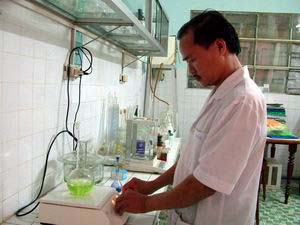 |
Laboratory staff at Binh Dinh provincial preventive medicine
doing regular check on food samples. |
The human resource crisis is also embroiling the preventive health sector, which has to do with everyday health problems of the community, especially the new and emerging diseases. It is quite an absurdity that those involved in preventive medicine have to deal with a great number of difficulties relating to working conditions and family happiness, are paid poorly. Therefore, a shift of medical staff from public to private health sectors is becoming apparent. In addition, high vacancy of senior health posts in the preventive health facilities are well documented. A recent data found on average, those with post-graduate education (Medical Doctors of Philosophy, Masters of health, Medical doctors of specialty I and II levels) account only from 12-15% in preventive health institutes. Even worse, while a small number of newly graduated general practitioners joined the preventive medicine, a greater number left the sector.
A question has come into being: Why is that at present, the national training system in on the way of development, together with the increasing needs of health care services of the whole population, the human resource shortage is more severe?
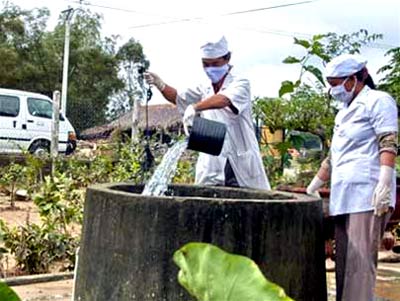 |
Medical workers from Danang Centre of Medical Prevention treating
flooded wells for water sanitaion. |
- One of the reasons is to do with the unsatisfactory incentives. It has been of great concerns that those with more than 30 years in service receive only 2-3 million VND per head per month, far below those earn from the private sector (approximately 7-15 million/head/month). Those who have just joined the health workforce are paid much poorer, just around 1 million per month. Other additional amounts (in light of Decree 43/2006/ND-CP promulgating on self-reliance of organisation, financial and revenue issues for the administrative offices) seem very small, not covering any tiny expenses.
- Another reason comes from the poorhuman resources planning and management practices in the preventive health sector. While the intermediate-level health staff account for a majority, those with higher levels stand a negligible amount. This, coupled with the "equalization in salary payment, ie. similar salary system regardless of different levels of education", has detered the motivation and enthusiasm of highly-qualified health staff. In addition, the resignation or death of those senior staff without immediate substitutions has attributed to the worserning shortage of human resources for health.
- Last but not least, the undeniable reason has been as a result of the national integration into the international market economy. This has caused a "brain drain" of high-quality and senior staff from public health to private heath sector in search of more lucrative jobs, which is continuing at an increasing level.
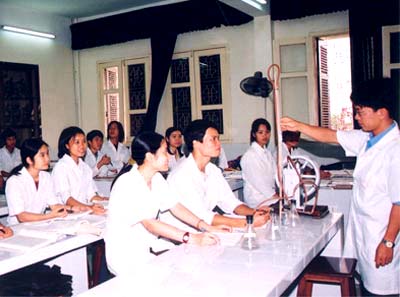 |
With the target of getting 50 medical workers/10,000 population until 2020,
the problem of "quality or quantity" in training human resource for health is still a big
challenge (Courtesy: website from Hanoi Medical University) |
Solutions for developing the human resource for health
In order to address the human resources shortage, the Ministry of Health has introduced guidelines and recommendations for pushing up the coordinations between education institutions such as medical universities, colleges and vocational schools and research institutes and provincial medical centres nationwide to ensure the provision of sustainable medical workforce. Another intervention includes measures to involve the investments from other sectors into health workforce provision. More importantly, the allocation of medical workers especially in underserved and rural areas together with additional incentives and housing should be taken into consideration. In addition, there should be reforms in medical education which stipulates a special allocation of student admission quota to candidates from underserved and rural areas into medical universities nationwide. Furthermore, "Top-ups" should be given for those involved in medical care activities, especially the preventive health sector. Lastly, the Ministry of Health should provide favourable conditions for health institutions to active seek for foreign investments in terms of scientific research and medical services.