On July 16, 2009, in order to evaluate the results of first half of 2009 and strengthen activities for the last half of 2009 in Northen Vietnam, the National Institue of Malariology-Parasitology and Entomology (NIMPE) held the workshop on "Reviewing malaria control activities for the first half of 2009" in Cua Lo town, Nghe An province.
Participated in the workshop were the leader of Preventive Medicine and Environment Department at the Ministry of Health, representative of WHO office in Vietnam, leaderships from NIMPE, IMPE-Quy Nhon, IMPE-Ho Chi Minh city; Director of Nghe An Health Service as the host of the workshop, representatives from the Institutes, Provincial malaria control centres/provincial centres for preventive medicine in Northern Vietnam.
The workshop received report presentations on the results of malaria control activities in the first half of 2009 by directors of the Institutes, on plans for malaria control in the last half of 2009 together with discussions from representatives.
Malaria situation in the first 6 months of 2009 against the same period of 2008
According to the statistics of first 5 months of 2009 against the same period of last year, there were no malaria outbreaks, but 7 deaths from malaria; malaria patients only reduced by 5.8% (20,914/22,215), severe malaria increased by 44% (72/50) and malaria parasites increased by 24.3% (4,619/3,716).
Among the reported 7 deaths from malaria, 4 were from the Southern region (Binh Phuoc 2, An Giang 1, Dong Thap 1) and 3 remaining cases were from Central Vietnam (Dak Nong, Gia Lai, Ninh Thuan 1 death for each), no death was reported in the North.
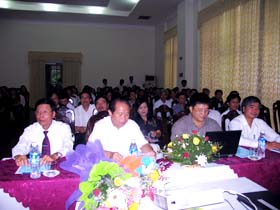 | 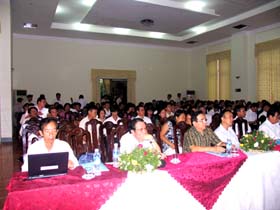 |
Participants to | the Workshop. |
The increased morbidity was mainly in West Highlands (+9.9%) and 18/63 provinces/cities (Thai Nguyen, Phu Tho, Hoa Binh, Hai Phong, Quang Tri, Quang Nam, Phu Yen, Ninh Thuan, Binh Thuan, Gia Lai, Lam Dong, Dong Nai, Binh Duong, Tay Ninh, Ho Chi Minh city, Ben Tre, Dong Thap, Soc Trang); severe malaria cases increased in Southern Vietnam (+112.5%) and West Highlands (+50%); malaria parasites increased in the central Coastal area (+50.6%), and West Highlands (+38.2%).
Evaluation of malaria control activities after first half of 2009
The achieved activities:
The National Malaria Control Project concentrated on severely-hit areas, providing enough anti-malaria drugs, insecticides, materials for localities for any campaign. In the first half of 2009, the IMPEs offered notice warning of possible outbreaks and provided guidelines for malaria control measures effectively; enhanced the quality of diagnosis and treatment; strengthened health communication and education for malaria control and the management of materials and budgets.
Some shortcomings:
The collection of information and reporting systems was still slow and inadequate; the quality of epidemiological surveillance was not appropriate enough; especially, difficulties existed in management of mobilised population. For malaria diagnosis and treatment, about 80% of the antimalaria drugs for trreatment was abused. This, together with the untimely treatment of severe cases at communal levels contributed to complication development and malaria deaths. In addition, the quality of malaria diagnosis and treatment was not as high, especially the microscopic points without sending slides for inspection as regulated.
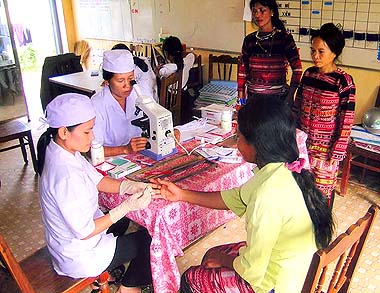
|
Taking blood slides for malaria dectection. |
Major activities for the last half of 2009
Concentrate on surveillance and direction in severely-hit and high-risk areas; especially those with increasing malaria situation and with natural disasters; monitor and apply self-treatment measures for mobilised population, or those with malaria upon coming from malaria-endemic areas; enhance the quality of diagnosis and treatment to reduce deaths from malaria.
Deploy indoor residual spraying and bednet impregnation o n the basis of interventional malaria epidemiological stratification of malaria epidemiology; especially spray in severely-hit areas.
Enhance the quality of spraying and bednet impregnation; the Institue and provinces need to strengthen surveillance of spraying and bednet impregnation.
Propagate people to sleep in bednets, take bednets when going to the forests.