During 10-12 November, 2009 the Planning workshop for helminthiasis control program period 2011-2015 was held at the National Institute of Malariology-Parasitology and Entomology (NIMPE), sponsored by the World Health Organisation (WHO)
Delegates to the workshop included leaderships from the NIMPE, the Institute of Malariology-Parasitology and Entomology, Quy Nhon (IMPE-QN) and the Institute of Malariology-Parasitology and Entomology, Hochiminh City (IMPE-HCMC); representatives from the WHO to Vietnam, the Hanoi Medical University, National Institute of Nutrition, Institute of Animal Health; and leaders and staff from 14 provincial malaria stations/provincial centres of preventive medicine of Ha Giang, Lai Chau, Yen Bai, Nam Dinh, Thanh Hoa, Hoa Binh, Thua Thien-Hue, Binh Dinh, Quang Nam, Ben Tre, Dak Lak, Binh Phuoc, Tay Ninh and Lam Dong.
The main objectives of the workshop was to evaluate the helminthiasis control activities carried out in the last year and, on the basis of presented discussions, to plan the helminthiasis control activities which will be proposed to the MoH and the Government for approval as the National Helminthiasis Control Program.
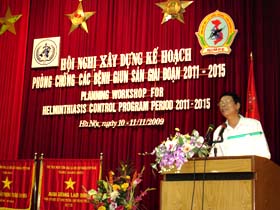 | 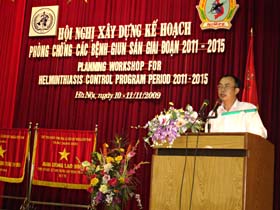 |
Dr. Nguyen Manh Hung, PhD., Director of NIMPE
opening the workshop | Dr.Tran Cong Dai, expert from the WHO's office in Vietnam
in his speech at the workshop |
After receiving the opening speech by Dr.Nguyen Manh Hung, PhD., Director-NIMPE, the workshop witnessed the presentations of reports from three institutes and several provinces on activities of soil-transmitted helminthiasis control for primary schools and pre-school children. Participants also contributed opinions and suggestions on the general and specific objectives, and the contents of activities for the target groups. The target groups of most concern are the pre-school children (from 24-60 months old) and women at childbirth ages.
Regarding the parasitic diseases caused by food-born trematoda and cestoda, some reports raised concerns of cestode flea infection for the health sector nationwide. At the workshop, priority solutions were discussed depending on areas or regions and on levels of infection. However, there should be integrated solutions such as the establishment and improvement of the specific health-care system, intervention and control, baseline research, training, involvement of human resource, health education and communication, and surveillance. The workshop briefed all the contributing ideas and suggestions for the expert group to submit the project proposal to the MoH and the Goverment.
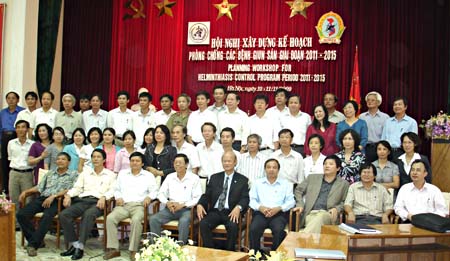 |
Participants to the workshop |
Hopefully the MoH and the Government will take initiatives for the making of the national helminthiasis control program, which will operate regularly deal with the "neglected" diseases, less dangerous but causing considerable impacts on the people's health.