The Health Ministry launched a mosquito-killing drive across the country on October 21 in the context of dengue fever spreading in central and southern regions and the discovery of the 7th infection of Zika virus.
Second mosquito-killing campaign launched
The campaign, the second of its kind, will be conducted through October and November with the goal of getting local authorities, all agencies and every resident involved in disease prevention measures.
The Health Ministry asks provincial health departments to guide locals in how to stop mosquito from breeding by keeping their water containers clean and advise local authorities on imposing administrative fines on individuals and organisations who refuse to take preventive measures against the diseases.
Communication work needs to be promoted via mass media and in all daily public activities to raise public awareness about their role in disease prevention.
The health sector will strengthen their monitoring and supervision of patients and quarantine work at border gates, while collecting more samples of suspected cases for tests.
Zika is mainly transmitted through the Aedes Aegypti mosquito, which also carries dengue fever. The virus causes only mild symptoms in most, including fever, sore eyes and a rash. But pregnant women infected with the virus risk giving birth to babies with microcephaly.
As of October 17, seven cases of Zika infection were confirmed in the central provinces of Khanh Hoa and Phu Yen, Binh Duong province and Ho Chi Minh City in the south.
 |
Health Minister Nguyen Thi Kim Tien directly steers the mosquito-killing campaign to control
Zika and dengue. |
Hanoi health sector works to prevent epidemics
The health sector of Hanoi has built a monitoring system for early detection of epidemics across the locality as part of efforts to improve the city's capacity to prevent and control diseases.
The sector has focused on increasing major supervision systems in hospitals at district and city levels as well as central hospitals located in the city, while keeping a close watch on newly-emerging diseases and dangerous epidemics for early detection and settlement.
It has implemented a project to enhance the efficiency of the supervision and early warning system to make quick response to a number of fatal communicable diseases in Hanoi until 2020.
At the same time, the sector has made a preventive medicine training plan, focusing on teaching health workers at all levels how to prevent and deal with epidemics. It has also exchanged information on epidemic supervision while strengthening the application of information technology, modernising the database management, and improving the forecast system.
Health care programmes in Hanoi have proven effective. After 30 years, the expanded immunisation programme has provided vaccines against eight dangerous diseases to 99 percent of under-one-year-old children in the city.
Since 2014, 98.2 percent of children between 1-14 years old and 95.5 percent of children at the age of 16-17 have received measles-rubella vaccines, while 97.2 percent of children in high-risk areas have got shots against Japanese encephalitis.
The city has cut the crude birth rate to 15.8 births per 1,000 persons, while decreasing the ratio of third child to 7.13 percent and reducing the number of under-five-year-old malnourished children to 9.2 percent. In addition, 92.63 percent of communes across the city have met national medical standards.
Hanoi has also formed well-equipped mobile teams for epidemic prevention and control with the aim to prevent any pandemics from spreading in the community. It has also effectively implemented national target programmes against major social and dangerous diseases, including HIV/AIDS.
Deputy Director of the municipal Heath Department Hoang Duc Hanh held that the sector should continue its efforts to prevent the outbreak of dangerous diseases, adding the city should enhance the quality of national health standards in line with new criteria of the Ministry of Health.
Hanoi strives to have 17 more communes meet the standards in 2016, raising the total number to 558, or 95 percent and reaching 100 percent in 2017, he said.
 |
Testing for Zika virus at international standard biological laboratotory. |
HCM City expands Zika virus monitoring network
Ho Chi Minh City's Health Department said it launched 15 more points for screening and detecting Zika virus infections in the context of increasing number of infections in the city.
As a result, the city now has 45 screening facilities, comprising 30 public hospitals and 15 private clinics.
District 2 has recorded the most Zika virus cases, so it is necessary to intensify inspection in the district for timely detecting new cases, said director of the department Nguyen Tan Binh.
He recommended locals to go for health checks and test early if they have symptoms like fever, hives and conjunctivitis.
Previously, nearly 800 samples were taken at 30 stations for testing, four of which tested positive for Zika virus.
Doctor Vo Thanh Tung from District 2 Hospital said his hospital takes samples for testing from about 10-15 patients each day, adding that many patients to the hospital have also sought advice on preventative measures.
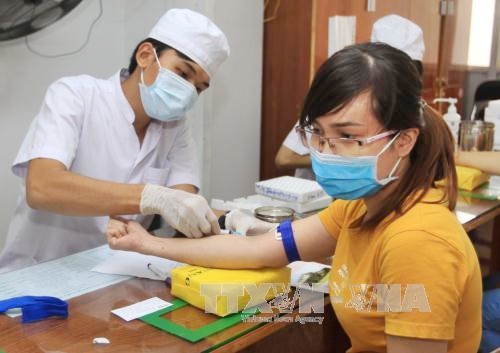 |
Taking blood samples for test (Source: VNA) |
The municipal Health Department will equip the city's Preventative Health Centre with more devices for testing, towards strengthening monitoring and supervision of Zika virus-related diseases.
It will also intensify communication campaigns to call on locals to be active in killing mosquitoes around their living areas.
As of October 17, seven cases of Zika infection were confirmed in the central provinces of Khanh Hoa and Phu Yen and Binh Duong province and Ho Chi Minh City in the south.
The Ministry of Health (MoH) has increased the Zika virus warning to level 3 - the dangerous level.
Zika is mainly transmitted through the Aedes Aegypti mosquito, which also carries dengue fever. The virus causes only mild symptoms in most, including fever, sore eyes and a rash. But pregnant women infected with the virus risk giving birth to babies with microcephaly.