Confronted with the complicated malaria situation in many localities throughout the country, on June 25, 2010the Department of Preventive Medicine (Ministry of Health-MoH) issued the Document No. 219/DP-DT on strengthening malaria control to directors of malaria prevention centers/centers for preventive medicine of the provinces/cities and to the institutes of malariology, parasitology and entomology nationwide.
According to the reports of the institutes of malariology, parasitology and entomology, themalaria situation in the first half of the year has tended complicated. In the first four months of 2010, there were 15,952 malaria cases recorded, as compared with the same period of 2009, increased by 0.84%, with the Central Coastal area 30.44% higher and theWest Highlands19.8%up; in particular, malaria parasites increased 43.37% against the corresponding period last year in all four regions: Central (78.35%), North (77.14%), West Highlands (67.58%) and South (6.36%).
To ensure the implementation of malaria control targets in 2010 with no malaria outbreaks, the Preventive Medicine Department (MoH) required the institutes of malariology, parasitology and entomology and malaria control centers/centers for preventive medicine of the provinces/cities to strengthen malaria epidemiological surveillance at hot spots and severely-hit, remote and outreached areas of malaria, areas with mobilised people and border crossing, especially in the regional provinces of Central Vietnam. Organizing courses of insecticide spraying in the areas with risks of malaria epidemic and high rates of malaria parasites under the guidance of the institutes of malariology, parasitology and entomology in charge. Conducting the supervision and evaluation of insecticide impregnation/spraying, ensuring enough drugs, chemicals, supplies and means of the malaria prevention programme for health care facilities at grassroots level. Strengthening the management and treatment of malaria cases in accordance with treating regimen, ensuring adequate drugs for objects with risk of malaria infection such as those who go to work in the forests and spend the nights in the field-huts without sleeping under a bednet or cross border. Extensively propagandizing the malaria control measures on the mass media in the areas with high risk of malaria. Reporting the outbreaks according to the Decision No 4880/2002/QD-BYT on December 6, 2002 of the Minister of Health on the regulations of informing and reporting infectious diseases causing epidemics.
Implementing the directive official dispatch of the Preventive Medicine Department (MoH), the provinces of Central Vietnam have strengthened the malaria epidemiological surveillance in severely-hit and high-risk areas of malaria, particularly enhancing malaria control measures in the first half of 2010 (insecticide residual spraying, bed-nets impregnation, treatment and mass communication and education for malaria prevention, etc.), thus containing malaria outbreaks and reducing malaria mortality considerably against the same period of 2009.
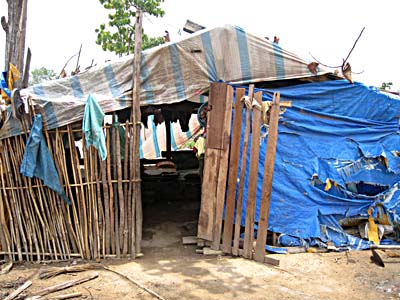 |
Mobilised people living in some communes of Dak Lak province. |
It is forecasted that, from now until late 2010, the malaria situation will develop complicatedly with high risk of malaria outbreaks. The institutes of malariology, parasitology and entomology were unanimous in holding the Regional Meeting on Malaria Control for the North Vietnam in Ha Tinh province (on July 22, 2010), for the Central Vietnam in Quy Nhon City (on July 27, 2010) and for the South Vietnam-Lam Dong in Ho Chi Minh City (on July 30, 2010). The contents of the meeting focus on the evaluation of malaria situation in the first 6 months and solutions for the second half of the year as well as the agreement in the plan of malaria epidemiological stratification, since then proposing the measures for the direction of malaria control in accordance with the current malaria situation and preparing for setting up the malaria control plan in 2011.