The vector control is currently one of the important tasks in the national programme of dengue control. In orderto prevent dengue-transmitting mosquitoes effectively, it is necessary to have a timely grasp of the sensitivity and resistance of dengue vectors to insecticides in every region and the mosquito-killing effect of each chemical at various amounts, thereby giving proposals for and guidance on the use of insecticide suitable with every locality.
So far, the resistance of Ae. aegypti mosquito to most of insecticides has been reported all over the world (World Health Organization, 2006). Therefore, the assessment of the sensitivity of Aedes aegypti to insect repellent in Vietnam and the establishment of epidemiological map of insecticide resistance in Aedes aegypti would contribute to set up strategy of using insecticides to prevent dengue fever / dengue haemorrhagic fever (DF/DHF) in Vietnam. Especially, Central Vietnam is a region with drastical increase of DF/DHF in 2010 against in 2009 and other regions in the country as well as complicated fluctuation of dengue-transmitting mosquitoes; more insecticides are also used in this region. Accordingly, several mosquito species presently resist insecticides or increase their resistance, including dengue vectors.
In order to set up the list of insecticides used in DF/DHF control period 2010-2012, on August 25, 2010, at the Office of the Ministry of Health (MoH), the Department of Preventive Medicine (DoPM) held the scientific board meeting on the use of insecticides in DF/DHF prevention, presided by Prof. Trinh Quan Huan, Vice Minister of MoH. Participants to the meeting included leaders and specialists of DoPM, Department of Health Environmental Management and leaderships and experts in dengue control from the National Institute of Hygiene and Epidemiology, Pasteur Institute Nha Trang, Institute of Hygiene and Epidemiology Tay Nguyen, Pasteur Institute Ho Chi Minh, National Institute of Malariology Parasitology and Entomology, Institute of Malariology Parasitology and Entomology Quy Nhon and Institute of Malariology Parasitology and Entomology Ho Chi Minh .
The meeting discussed a number of important issues such as the use of mosquitoe repellent in the dengue prevention at present, the research results of sensitivity level of Ae. aegypti to insecticides, and the mosquito-killing effect of ULV-spraying chemicals in different concentrations in the field as well as proposal of list of insecticides used in dengue control period 2010 -2012.
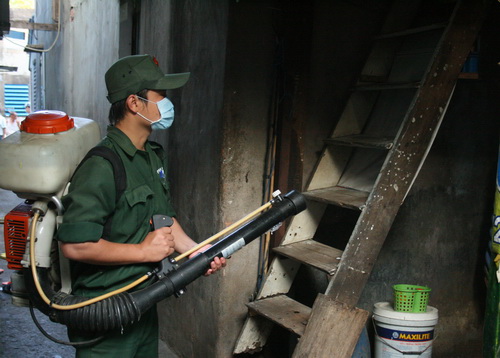 |
Insecticide spraying at a household in Ho Chi Minh City. Photo. Q.Khai |
Besides, the Scientific Board also put forward strengthening measures to improve the effectiveness of insecticide spraying; for examples, enhancing mass communication and education to raise the community's awareness, hence receiving people's positive respond to campaigns of mosquito larva extermination as well as insecticide spraying; training of health staff on techniques of insecticide spraying, epidemic nidus treatment, etc.
The results of the meeting will be submitted for the MoH's consideration and approval in the earliest time so that the localities and project implementating units could implement the dengue control effectively.