In the first 9 months of 2013, the situation of malaria in the Central Vietnam developed complicatedly, especially in the first months of rainy season and the second peak of malaria transmission seasons. The increase of malaria morbidity was in the provinces of Quang Nam, Gia Lai, Khanh Hoa, Ninh Thuan, etc.
The cause of increased malaria cases is mainly due to people going to the forest and sleeping in the field huts for their cultivation or go to forests to exploit forest and native products. Their families often live and work in fields during farming seasons. However, their awareness about malaria control measures was weak; for examples, these groups often don’t sleep under bednets or bring bednets but not use them because the field-hut was too small to hang a bednet, some even think that if they are drunk on wine, the mosquitoes biting them will also get drunk, etc. This remains the biggest difficulty in malaria control in Central Vietnam (forest malaria).
In July 2013, in To Hap town, Khanh Son district, Khanh Hoa province, there are 70 malaria cases positive with malaria parasites, with the infection rate of P.falciparum of 81.4%, P.vivax 11.4 %, mixed infection 7.2%; moreover, malaria parasites have presented in most of age groups with 14 positive cases found in the 1- 8 age range; 17 cases aged between 9 and 16; 29 cases aged 16 and above. The entomological surveillance at field huts showed the presence of main vector An.minimus. If there is not any timely interventional measures, malaria outbreaks will occur and cause deaths from malaria.
 |
 |
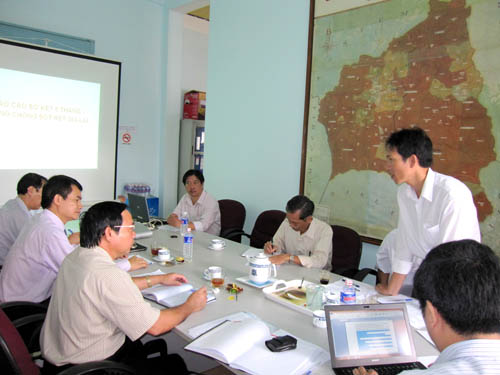
Dr. Nguyen Van Chuong, Director directing malaria control activities in some of provinces |
In Gia Lai province
In the first 8 months of 2013, the province had 2,080 malaria cases, of which 1,890 cases positive with malaria parasites. This province always has the highest number of malaria parasites infection compared with that of other provinces. From July 2013, the malaria morbidity rate began increasing in the districts of Krong Pa, Kong Chro, Iapa, Iagrai, Duc Co, Ajunpa. Typically, just in August 2013, at the communes of ChuRcam, Chu Ga, each commune had from 27 to 30 malaria cases; even in some communes of Duc Co district, 80% malaria patients brought the hypnozoite of malaria parasites. This is a warning that the surveilance and treatment of malaria should be carried out thoroughly to prevent malaria outbreaks from occuring.
In Ninh Thuan province
In first 8 months of 2013, there were 753 malaria patients, of which 721 cases positive with malaria parasites malaria parasites. The number of malaria patients tended to increase from June 2013, especially in September 2013. The surveillance mission team of EpidemiologicalDepartment, IMPE-Quy Nhon detected 25/440 malaria parasites cases in Ma Noi commune, Ninh Son district, Ninh Thuan province, making up 5.68%. Besides, some of communes of Nam Tra My district, Quang Nam province also had the increased rate of malaria morbidity.
At the workshop on anti-malarial preliminary review in first 6 months of 2013, the leader of IMPE-Quy Nhon has directed the provinces to carry out the survey and assessment of "hotspots" at districts, provinces to detect and treat disease sources actively; on the other hand, the leaders of the IMPE-QN directly went to the communes, districts of the provinces having increased rate of malaria morbidity to steered control measures timely. Besides, the surveillance mission teams of departments of Epidemiology, Entomology and Malaria Research were assigned to control the disease together with the provinces. The Institute supported drugs, chemicals and human resource to deal with "hot spots".  |
Working at the communal health station of Ma Noi |
 |
Working at the Provincial Centre of Malariology, Parasitology and Entomology of Khanh Hoa |
The central coastal area is entering the rainy season with many floods threating the control activities of epidemic diseases, especially malaria, so the malaria surveillance and control activities need to be strengthened at all levels. The areas which have taken initiative in surveillance can definitely take timely detection and containment of malaria outbreaks, reducing rate of malaria deaths, increasing effectiveness and lowering economic cost in malaria control. on the contrary, if the areas are inattentive and subjective in malaria control, risk of outbreaks can occur and control activities will become more difficult and costly.