With the investment of the Government and other international organizations, in recent five years, the indexes of malaria morbidity, malaria mortality and severe and complicated malaria have reduced significantly. However, the malaria control for mobilised populations (free migrants, forest goers, field-hut doers, border-crossers, etc.) has still met lots of difficulties whereas most of the whole country's malaria deaths and infected cases have been mainly found in this subjects.
On 12-13 August 2013, in Binh Phuoc province, the World Health Organization and IMPE-Ho Chi Minh held the Workshop on malaria control for mobilised populations. Participants to the workshop included representatives of WHO in Vietnam, experts of General Department of Preventive Medicine-MoH, leaders and staff of institutes of malariology, parasitology and entomology, provincial health deparment of Binh Phuoc, provincial malaria control centers/centers for preventive medicine of Lam Dong, Dak Nong, Dak Lak, Gia Lai, Kon Tum, Binh Phuoc; district health centres, district people's committee and some communal health stations of Bu Gia Map and Bu Dang district (Binh Phuoc province) that have occurred mobilised poplultions recently.
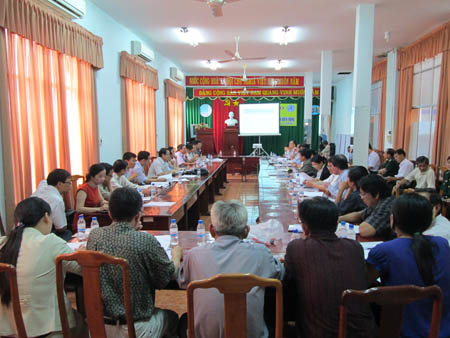 |
Participants to the Workshop |
Before attending the workshop, the representatives had visited to and worked with local authorities of Dak O commune, Bu Gia Map district to collect information about population mobility, control of mobilised people and malaria situation in this commune. At the workshop, the representatives has listened reports on the people movements to malaria-endemic areas and malaria control for mobilised populations in the South region-Lam Dong (under the management of IMPE-Ho Chi Minh) and the Central region-West Highlands (under the management IMPE-Quy Nhon); reports of the Provincial Malaria Control Centre of Dak Lak on emigrants and malaria in Dak Lak province period 2001-2012; those of the Provincial Malaria Control Centre of Gia Lai on forest going, field-hut doing and population mobility in Gia Lai; those of the District Health Center of Bu Gia Map on malaria control for mobilised populations in Bu Gia Map district (Binh Phuoc province); reports of the Communal Health Stations of Dak O on malaria situation and malaria control at locality. The workshop representatives have discussed and provided antimalarial measures for mobilised people, focussing on four main contents:
1. !important; Measures to control mobilised people to malaria-endemic areas;
2. !important; Measures to control malaria vectors for mobilised people to malaria-endemic areas;
3. !important; Measures to do intervention, diagnosis and treatment of mobilised people;
4. !important; Health communication and education about malaria control for mobilised people.
However, in many recent years, the studies on antimalarial measures for these objects haven't achieved the desired results. The malaria control measures for mobilised population groups remain a difficult problem and a challenge to the National Malaria Control and Elimination Programme at present.
The workshop ended successfully. Hoping that the contents and measures of controlling malaria for mobilised people will be soon applied in the coming time so as to reduce the malaria morbidity and mortality in these high-risk subjects.