Typhoon Ketsana caused serious consequences both materially and spiritually for the people of Kon Tum province. According to the statistics of Kon Tum Provincial People's Commttee, the Ketsana typhoon killed more than 50 people and caused property damage of over VND two thousand billion; especially Tumorong district being the most severely hit.
In order to overcome the damages by the typhoon, the NIMPE and IMPE-Quy Nhon supported 2,000 bednets, 175 litre of Fendona 10SC and VND 20 million to deploy activities at the grass-root levels.
With the supports from the IMPEs, the provincial malaria control centre of Kon Tum directed district health centres to overcome damages caused by the typhoon, involve human and material resources to carry out residual insecticidal sprayings at communes, allocate 2,000 bednets for the people in Tumorong district. Together with the vector control measures, the activities of detection and diagnosis were also carried out timely to prevent the development of malaria.
The provincial general hospital and eight district/city health centres were provided with anti-malaria drugs to strengthen monitoring, detection, diagnosis and treatment; and to actively control severe and complicated malaria cases and deaths from malaria. Particularly, attention should be paid to the imported cases from the Vietnamese-Laotian and Vietnam-Cambodian borders and from other provinces in the regions, for these admitted to hospitals with severe and complicated symptoms of malaria.
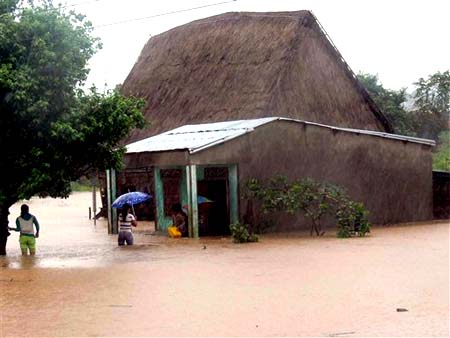 |
According to the statistics of Kon Tum Provincial People's Commttee, the Ketsana typhoon
killed more than 50 people and caused property damage of over VND two thousand billion.
Photo: AP |
Regarding the malaria situation of Kon Tum province in September, 2009, there were 1,170 malaria patients, 5 severe and complicated malaria cases and 1 death. There were totally 75,098 blood slides and rapid diagnostic tests (Paracheck Pf test)taken, resulting in the parasite rate of 0.21%. Four districts with highly-increased malaria rates were Ngoc Hoi, Sa Thay, Kon Plong, Kon Ray. In comparison with the same period of 2008, malaria morbidity decreased by 11.5%; severe and complicated cases increased by 80%; malaria parasite rate increased by 7%, but no occurred outbreaks.
With the supplemental interventional measures for overcoming the consequences of the Ketsana typhoon, Kon Tum province will try to stabilize malaria situation in the remaining months of 2009 and the following years to achieve the objectives of the National Malaria Control Programme and ready to transition into the "pre-elimination" stage set by the WHO.