The workshop on reviewing malaria control activities in first 6 months 2011 of the National Malaria Control Project (NMCP) was held in turns in Northern area (Ha Noi) on July 25, 2011, in the Central area (Quy Nhon) on July 27, 2011 and in Southern area-Lam Dong (Da Lat) on July 29, 2011. The achieved anti-malaria results in first 6 months of 2011 will give impetus to implement the Malaria Control and Elimination Strategy period 2011-2015 and vision to 2020.
Malaria situation
According to the statistic of National Malaria Control Project in first 5 months of 2011, malaria morbidity in the whole country, as compared with the same of last year, had 17,621 cases, decreasing by 12.8%; with the northern mountainous area (-3.36%), northern midland area (-2.29%), former Region IV (-18.85%), the central coastal area (-31.77%), the West Highlands (-26.46%) and the Southeast area (+25.94%).
The number of malaria parasite in the whole country were 5,717 cases, decreasing by 7.12% against the same period of last year, with the Northern area (-13.97%), the Central coastal area (-24.82%), the West Highlands (-20.62%), the Mekong Delta (-19.41%) and the Southeast area 51.27% higher.
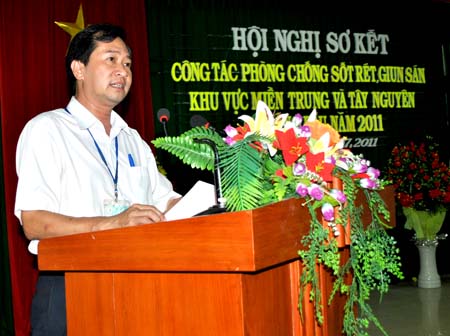 |
Dr. Ho Van Hoang - Vice director of IMPE-Quy Nhon introducing
the representatives at the workshop. |
Compared with the same period of last year, severe malaria cases in the whole country had 62, increasing by 24%, and there were 7 deaths from malaria, increasing by 16.7%.
Evaluation on malaria situation of the whole country in first 6 months of 2011
Most of areas of the whole country reported a decrease of malaria indexes, but the Central Vietnam and the Southeast area had the highest rate of malaria morbidity; especially in Southeast area, indexes of malaria morbidity and parasites still increased. Noticeably, there was a local increase of malaria morbidity in areas having decreased rates of malaria indexes for many years such as Binh Thanh commune (Tuy Phong district, Binh Thuan province) because cases of imported malaria increased without control. This is an experience of epidemiological surveillance which is not only implemented in severely hit areas but also in non-severely hit areas.
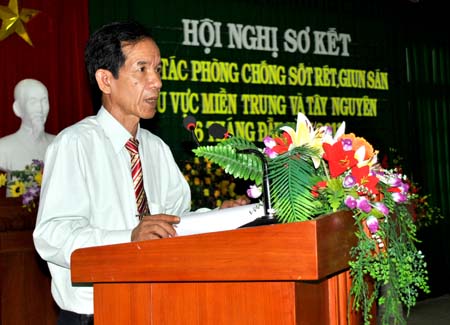 |
Assoc. Prof. Trieu Nguyen Trung - Director of IMPE-Quy Nhongiving speech at the workshop |
Malaria control activites in first 6 months of 2011
The management board of National Malaria Control Project signed the commitment on the provision of enough antimalarial drugs, chemical, materials and funds for local health services to deploy malaria control activities according to the given plan.
Malaria control measures concentrated on epidemiological surveillance, vector-borne surveillance and vector control, diagnosis and treatment, together with enhancing the ability of medical staff and strengthening health education and communication. Especially, the project provided drugs for self-treatment higher than 4.5 times against with antimalarial drugs in the whole country, with 3,145 cases of P.Falciparum was treated by ACTs-artemisinin-based combination therapies, making up 95.5%. In malaria control campaign, indoor insecticide spraying and bednet impregnation was carried out for 2,431,291 people at malaria-endemic areas. However, the coverage of intergrated measures only achieved 22% of population against the plan of 2011. Besides, health communication and education campaign on World Malaria Day April 25,2011 with the theme "Achieving Progress and Impact" was launched in the whole country for near 12,000,000 people-turns.
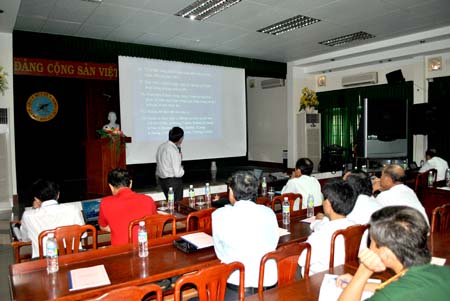 |
Dr. Nguyen Manh Hung, Director of NIMPE reporting on malaria situation of the whole country
in first 6 months of 2011 |
Difficulties and shortcomings
The biggest difficulty in malaria control is the management of mobilised people (free-migrant people, people working in the forest, sleeping in the field huts and crossing borders) and there is not feasible control measures for these groups. The malaria characteristic of Central Vietnam and Eastern South Vietnam is very diversified and complicated, the decrease of malaria indexes was not stable, so risk of outbreaks can happen highly; especially there is the appearance of malaria main vectors (An.minimus, An.dirus) at areas having decreased rate of malaria parasites.
In diagnosis and treatment of malaria, some provinces have less care about the technical problems, few medical staff at grass-root levels was trained new combination therapies (ACTs) promulgated by the Minitry of Health to treat for patients; meanwhile, in some areas, they still used conventional monotherapies in treatment.
Information collection from grassroot levels was slow, the quality of epidemiological surveillance and vector control activities was limited. Health communication and education was not really effective for the people on malaria control measures so that they can protect by themselve in malaria-endemic areas.
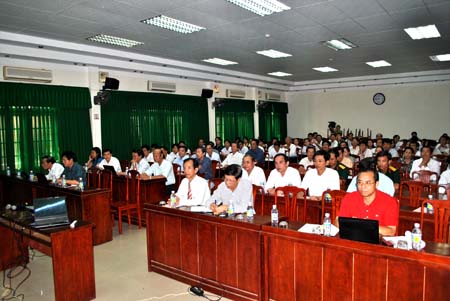 |
At the workshop |
Malaria control activities in last 6 months of 2011
In first 6 months of 2011, malaria control activities continued to be carried out to achieve the targets as follows:
Malaria control activities should be carried out actively at malaria-endemic areas, and deployed malaria elimination activities at areas having decreased rates in many consecutive years; by 2011, rate of malaria morbidity gained below 0.55/1000 people; rate of malaria deaths is below 0.02/100,000 people. Originally, the provinces achieved the norms of malaria control activities and continued to conduct the malaria elimination with the aim of contributing to heath protection for people.
The people are approached services of early diagnosis, timely treatment through private and public health facilities, gained 80% of malaria morbidity rate going for a medical examination and blood test at; 80% of patients having fever at malaria-endemic areas exammined for malaria parasites; above 95% of patients having malaria parasites P.falciparum treated with ACTs combination therapies; 62% of malaria morbidity treated with suitable therapies and enough dose. The coverage of malaria control measures are conductedfor people living in high-risk areas, with above 90% of people provided bednet impregnation with insecticides, above 97% of households protected by indoor residual spraying.
Enhancing rate of the people using malaria control measures and strengthening health communication and education. Above 92% of people living at malaria-endemic areas receive the message on malaria control, and above 88% of people sleep in bednets with insecticides. Enhancing the ability of epidemiological surveillance with 95% of hamlets, villages having medical staff working in malaria control field. Deploying malaria elimination activities in 16 provinces of hypo-endemic malaria areas and promulgating instructions and training on Malaria Control and Elimination Strategy.