On 2nd November, 2009, the Central Management Board of the Dengue Fever Control Project, a national target programme for controlling several emerging diseases, dangerous diseases and HIV/AIDS held a meeting at the Health Ministry office to evaluate the dengue fever situation in the first 10 months of 2009, the deployed epidemic control measures, the project plan in the last two months of 2009 and the operational plan for 2010.
Dengue fever situation on the world and in Vietnam
At the meeting, the Central Management Board of the Dengue Fever Control Project announced that up to now there are 27 countries and territories in the Asia-Pacific region reporting dengue fever cases, with some dengue fever outbreaks recorded in Australia, Cambodia, Lao PDR, Malaysia, Cook Island, New Caledonia, and Vietnam.
In Vietnam, the first 10 months of 2009 recorded about 77,068 cases of dengue fever/dengue hemorrhagic fever (DF/DHF) and 63 deaths reported, increasing 7.3% in the morbidity and decreasing 11.7% in the motality compared with the same period of 2008. South Vietnam provinces reported totally 57,927 DF/DHF cases and 53 deaths; against the same period of 2008, the mobidity reduced 8.2% and the motality reduced 24.3%. Some provinces with highly-infected rate included Tra Vinh, Kien Giang, Dong Thap, An Giang and Ho Chi Minh City. The Central Coastal area reported 8,657 dengue cases and 7 deaths; compared with the same period of 2008, the mobidity raised 8.2% and the motality raised 2 cases; some provinces with high incidence included Binh Dinh, Phu Yen, Da Nang, Thua Thien-Hue, and Quang Binh. The West Central Highlands reported 1,123 DF cases and 1 death; 58.1% higher in the morbidity and 1 death lower against the same period of 2008; with Dak Lak, Dak Nong and Kon Tum being the highest incidence provinces.
Evaluating the dengue fever situation in the first 10 months of 2009, the MoH's Preventive Medicine Department noted that the dengue fever situation in the northern area was of great concern with 9,361 infected cases, 4 times as much compared with the same period of 2008 and 2 deaths; especially in Ha Noi there were reportedly 8,786 DF cases (8.7 times as much compared with the same period of 2008) and 2 deaths. Some provinces with higher rates of morbidity and mortality included Ha Noi, Thanh Hoa, Hai Duong, Hung Yen, Vinh Phuc, Thai Binh and Quang Ninh.
Confronted with the ever-increasing and spreading situation of dengue fever outbreaks in many regions in the country, on October 26 2009, the Prime Minister issued the urgent Notice No. 2026/CD-TTg on the guidance of dengue fever control to ministers, leaders of ministry-equivalent bodies, chairmen of People's Committees of the provinces and cities directly under Central Government, requiring them to concentrate on the directions and implementation of the urgent duties so as to prevent outbreaks from prolonging, spreading and developing into pandemics.
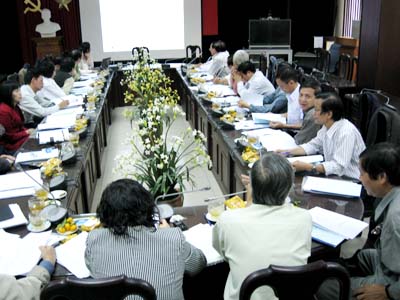 |
The Central Management Board of the Dengue Fever Control Project |
Activities of dengue fever control in the first 10 months of 2009
Deploying the campaigns of spraying insecticide and exterminating mosquito larva for DF control
Consequently, 20/20 provinces/cities in the south and 11/11 provinces/cities of the central region have finished the first-stage campaign with good results, contributing to the containment of dengue fever outbreaks. Meanwhile, although the capital city of Ha Noi and Thanh Hoa province in the North reportedly deployed the campaign, the larval indexes were still at high, resulting in new generations of dengue mosquitoes. Severely, West Highlands provinces haven't deployed the campaign.
Constructing and planning for the budget for dengue fever control project in 2009
The total granted expenditure is VND 70 billion, including the purposive supplemetary expenditure of VND 45 billion (issued by the Financial Ministry to localities), the central expenditure and the kind budget for localities (budget allocated by MoH's Decision). At present, the MoH is coordinating with the Financial Ministry to promulgate the joint circular on the content and standard of spending for dengue fever control project.
Focus of activities in the coming time
Deploy the Notice No. 2026/CD-TTg issued by the Prime Minister on October 26 2009. Strengthen the close supervision of epidemic situation, launch the environment hygiene campaign to control dengue fever and contagious diseases nationwide; maintain and consider these activities as routines by localities to actively control the outbreak. Continue deploying the plan of spraying insecticide and eliminating breeding sites of DF stage-2 larva in cities/provinces and holding post-campaign reviews for better implementation.
Health facilities prepare sufficient amounts of drugs, means of treatment and sickbeds to timely admit patients; strengthen training courses on diagnosis, classification, treatment and nursing for patients from all levels.
Concentrate on the health education for DF control, inform and praise the role-models and teams in DF control activities, at the same time criticize non-cooperative behaviours and bad habits that contribute to spread DF outbreaks in the community. The cities/ provinces report actively and promptly on epidemic control activities to the chairmen of People's Committees, assign specific responsibilities to all levels of local authorities.
Expenditure for dengue fever control in 2009
From the allocated expenditure, the principle of apportioning the purposive supplemetary budget to cities/provinces is based on the categories of the DF severely-hit provinces in terms of levels A, B, or C; on the population density of cities/provinces; on the number of population, districts, communes; on the provincial natural and social conditions; and the priority provisions of equipment for supervision and diagnosis to the provinces with high-risk of outbreaks. The activities which are given the supplemental expenditure support include active epidemiological monitoring, volunteer network, staff involved DF control, larval elimination and environmental sanitation; insecticidal spraying; training and retraining for expertise improvement; health education and communication; sampling, transport and examinations of medical specimen; transport of documents and other expenses for the provinces of A, B, C.
Right after the workshop, the MoH issued the Decision No. 4051/QD-BYT on the supplemetary allotment of the 2009's expenditure estimates of the DF control project, which belongs to the national target programme of controlling several social diseases, dangerous epidemics and HIV/AIDS so that concerned units actively carry out the dengue fever control activities which have been assigned till the end of 2009.
Several deliberated matters of the Dengue Control Project Management Board
At the meeting of the Central Management Board of the Dengue Fever Control Project, the discussed ideas concentrated on some matters as follows:
Technical expertise
The project implemetation in 2009 bred some problems relating to technical expertise; for example, insecticidal spraying showed ineffective due to people's non-cooperation (close the doors during spraying) or community's awareness in DF control not high; spraying technique didn't meet requirements; some localtities implemeted the dengue fever control project perfunctorily because of expenditure shortage; not to mention the possibility of mosquitoes' chemical resistance which reduces the effectiveness of activities.
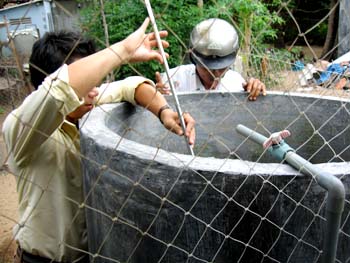 |
Checking larva at a malaria-endemic zone. |
The classification of provinces into A, B, C types was somehow inappropriate. For instance, Dak Nong, which was classified as the province of A, has stable DF situation; meanwhile, Dak Lak and Gia Lai, whose DF situation were more serious, were just classified as B. In addition, the provinces are paying more special attention to the influenza A (H1N1) control rather than dengue fever control.
Allocated expenditure and plan of disbursement
However, allocating expenditure in November 2009 was too late to timely disburse by December 2009. Several localities implemeted perfunctorily due to expenditure shortage, or until the budget were alloted they had no guidelines for spending. The activities of dengue fever control implemented from early this year could be payed while the Joint Circular 147 by the ministries of health and finance had no spending section for dengue fever. The communication expenditure of VND 13 million was too low to carry out at the community; and hospital system should be supported with an extra expenditure for dengue fever diagnosis and treatment due to admiting a great number of patients.
Although some problems haven't been solved yet, all members of the Central Management Board of the Dengue Fever Control Project are of highly unanimity on the prompt deployment of activities for the rest of 2009 in order to effectively carry out the urgent notice of the prime minister on the control of outbreaks and mortality due to dengue fever.